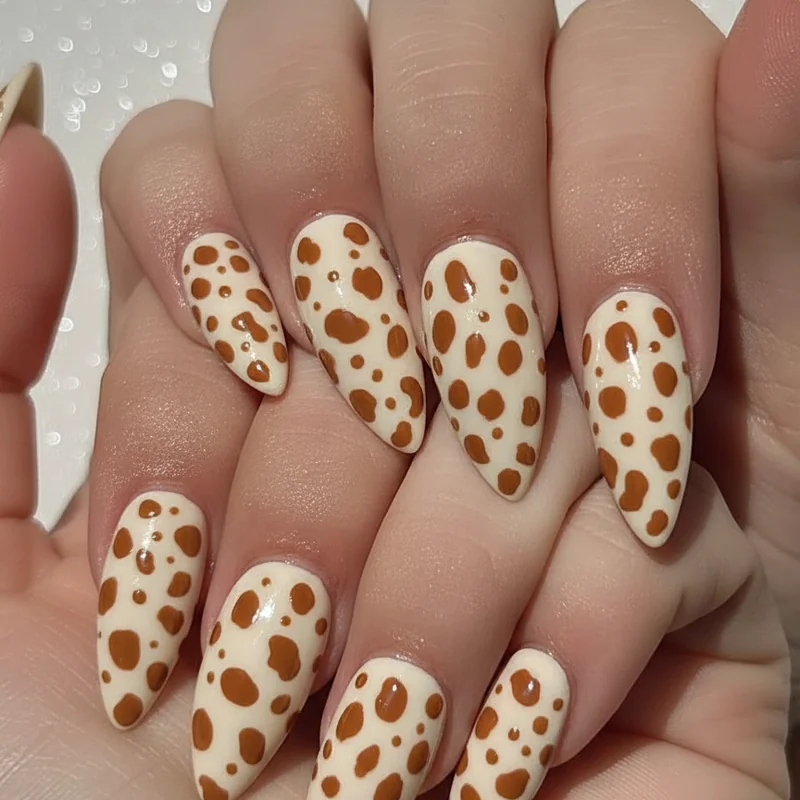
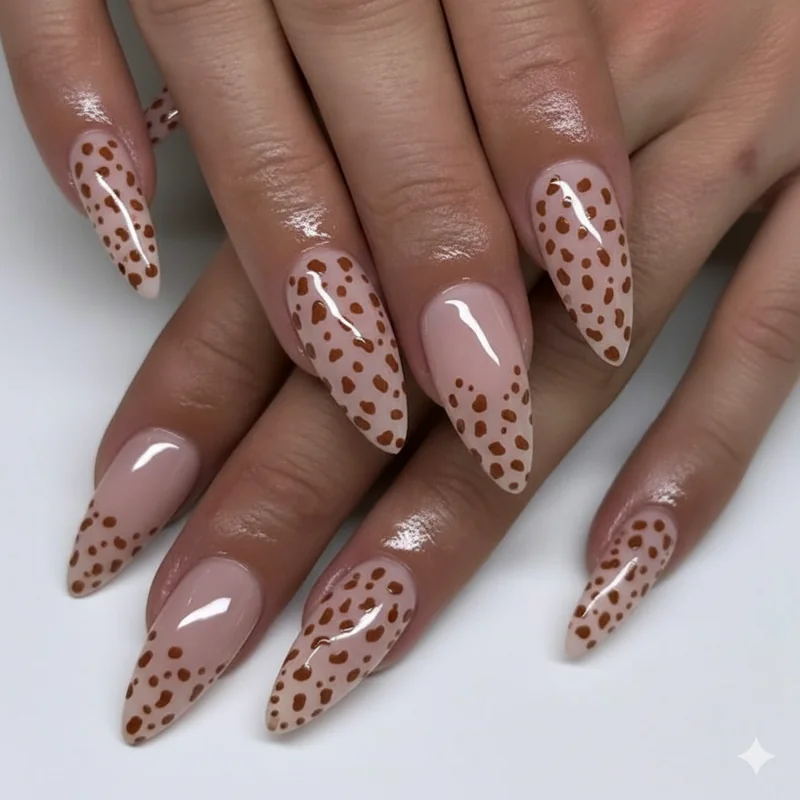
This is the animal print that does not announce itself. Bambi nails are the fawn-speckled manicure taking over every nail board worth following in 2026, and they work precisely because they are not trying to be seen from across the room. This is for the reader who has always found leopard a little much and cow print a little literal. Bambi nail art is warm, specific, and quietly beautiful. Right now, before the trend hits full saturation, it is the most interesting manicure you could be wearing.
The concept is straightforward: a warm brown base, cream or white speckles clustered in the organic, irregular way of a fawn's coat. But bambi nails have evolved well beyond that single description. There are versions that work in a boardroom and versions that belong on a Pinterest mood board for a forest cottage you will never own. Knowing which one suits you is the whole point of this post.
Why Bambi Nails Feel Different From Every Animal Print Before Them
Animal print has always been a statement. Leopard says one thing. Cow print says another. Both require a level of commitment: you either wear them or you do not, and the look knows the difference. Bambi nails ask nothing of the sort. They are animal print stripped of its bravado, swapping high-contrast drama for something that reads more like texture than pattern.
The cultural moment behind this shift has a name: the Wilderkind aesthetic. Identified by Pinterest Predicts 2026 as one of the defining aesthetics of the year, Wilderkind sits at the intersection of forest-core, nature-led design, and a broader retreat from clean-girl minimalism. It is not rustic or earthy in the expected sense. It is more poetic than that: fawn freckles, pressed leaves, butterfly-wing motifs, bark textures. The kind of beauty that feels like it grew rather than was constructed. Pinterest tracked a 55% increase in searches for the deer aesthetic in the lead-up to 2026. That is not a micro-trend. That is a mood shift.
Designers registered it before nail artists did. Tory Burch and David Koma both brought fawn-inspired motifs into their recent collections, moving deliberately away from bold contrast and toward something tactile and delicate. By the time those runway images landed on TikTok and Pinterest, nail artists had already translated the sensibility to fingertips. The soft girl winter nail trend connected the dots between wardrobe and manicure, and bambi nails became the most literal, wearable expression of the whole movement.
What separates this from every animal print before it is scale and softness. The speckles do not dominate the nail. They suggest. That restraint is the point, and it is also why this trend has a sophistication ceiling that leopard, for all its charm, never quite reaches. You can read more about how this fits into the wider 2026 beauty shift at what nails to wear every month in 2026.
What Bambi Nails Actually Look Like And the Variations That Matter
Three coats of the wrong brown and you have mushroom nails. The right brown, warm and not grey-toned, and suddenly you have something that reads fawn. Colour choice is where the bambi manicure either works or does not, before a single speckle is placed.
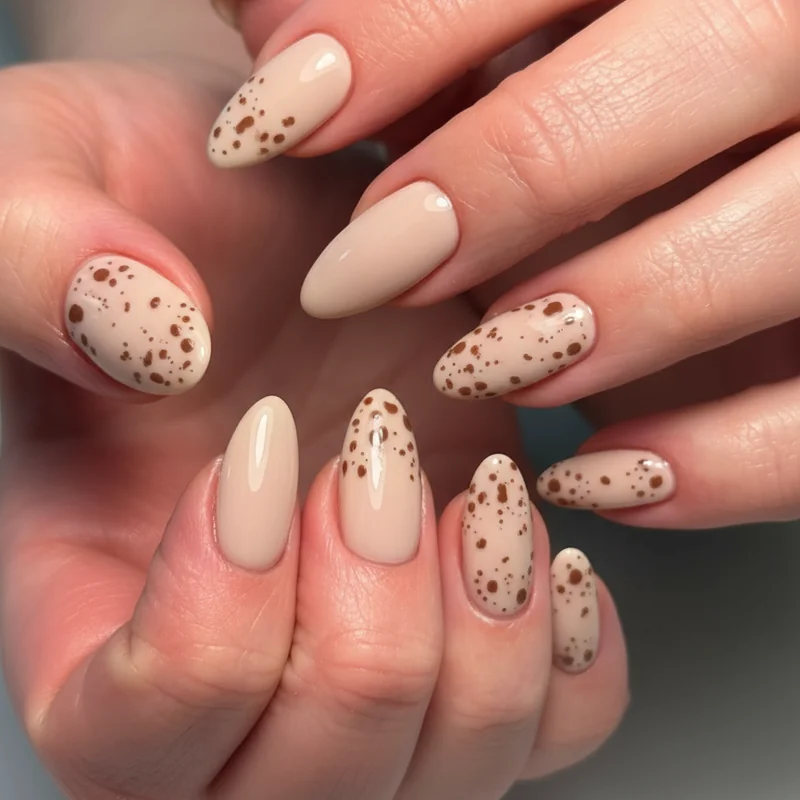
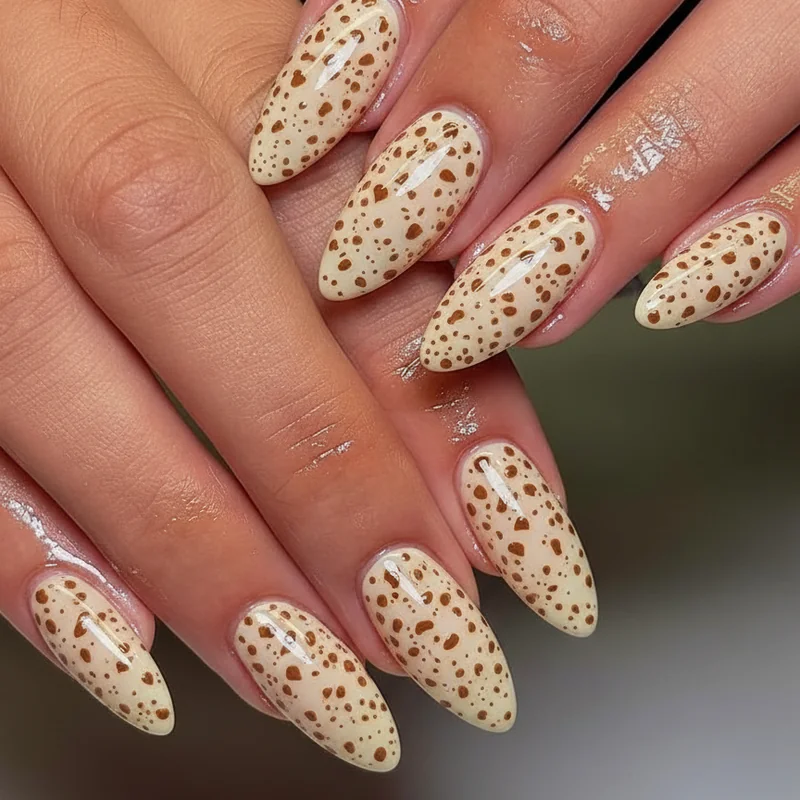
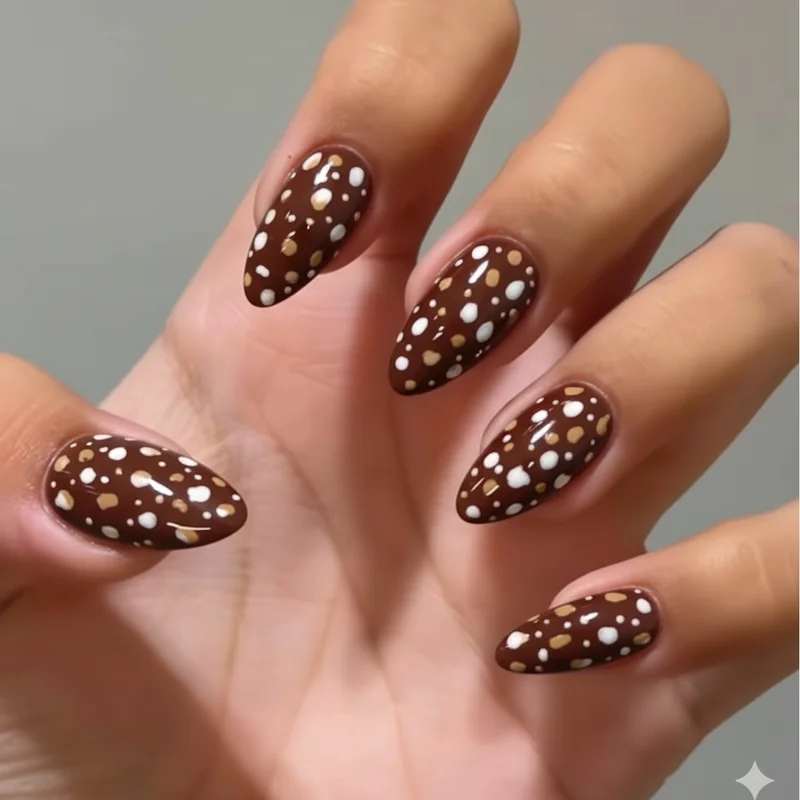
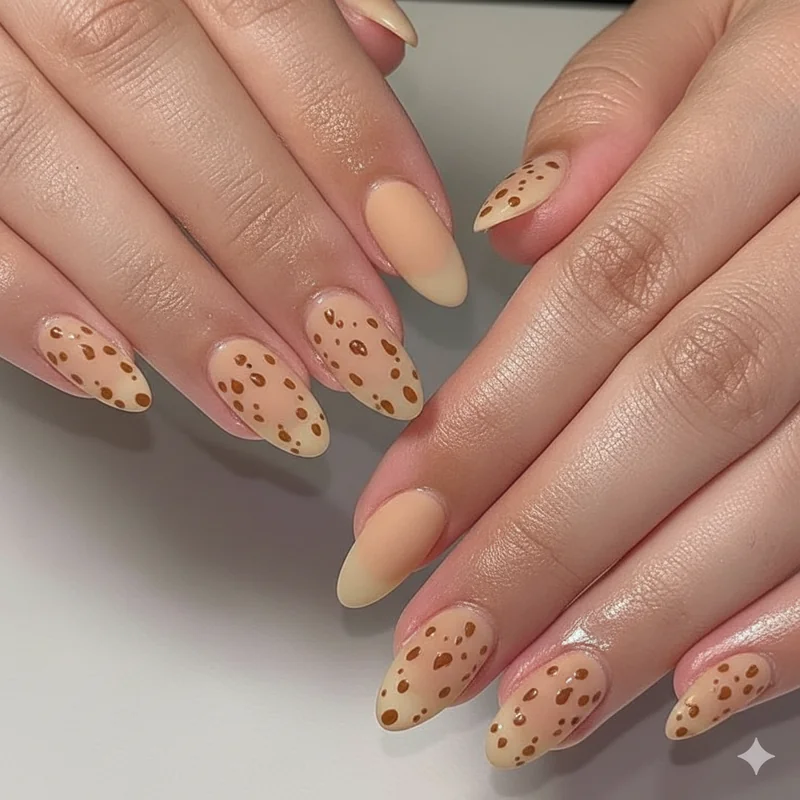
At its core, a bambi nail is a warm brown base (coffee, caramel, tawny, or toffee) with soft cream or sheer white speckles clustered loosely across the nail. The speckles are the fawn's coat: not polka dots, not leopard spots, but something organic and imprecise. That imprecision is the technique, not a flaw. You can see the full range of bambi print nail designs circulating now, from ultra-soft to high-contrast, but the most wearable versions stay in the soft-focus register.
The variations that have genuinely evolved the trend:
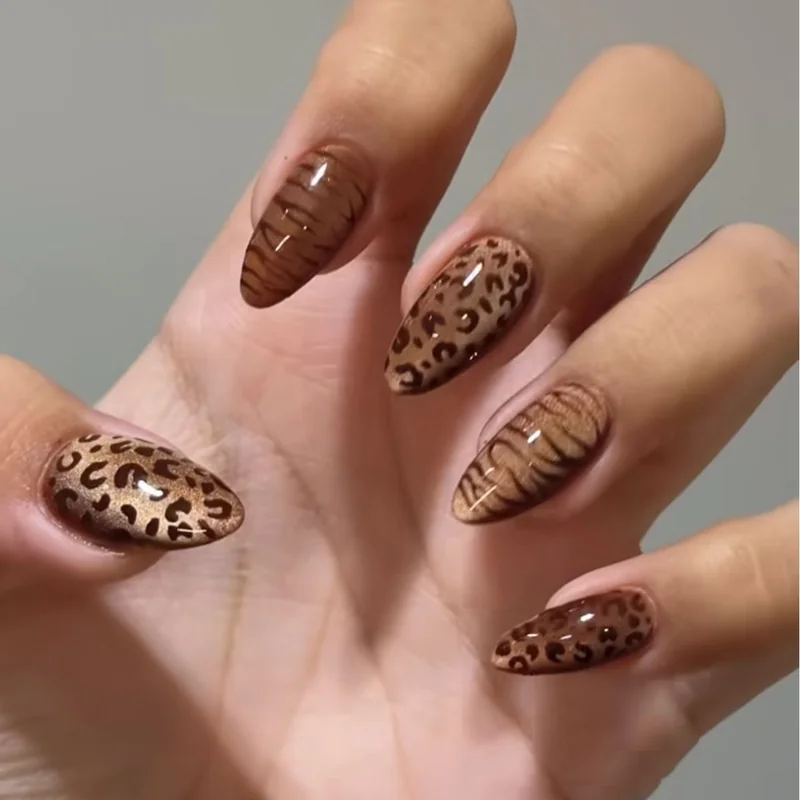
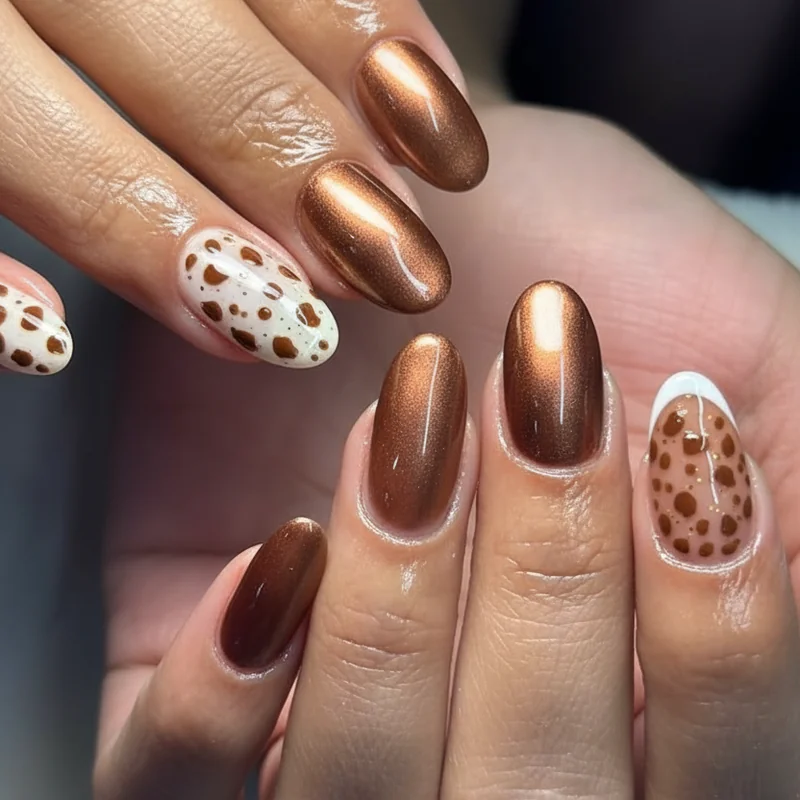
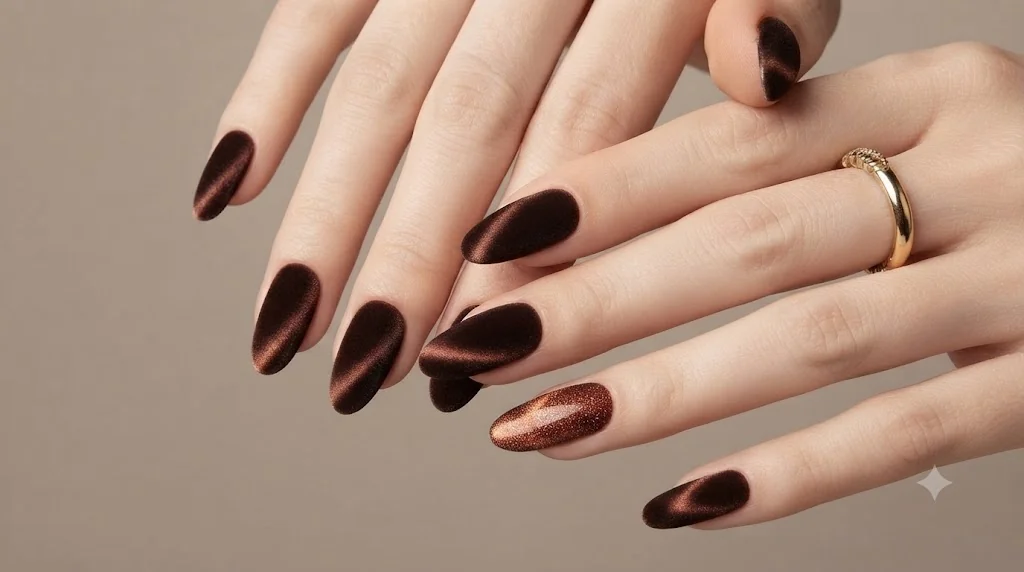
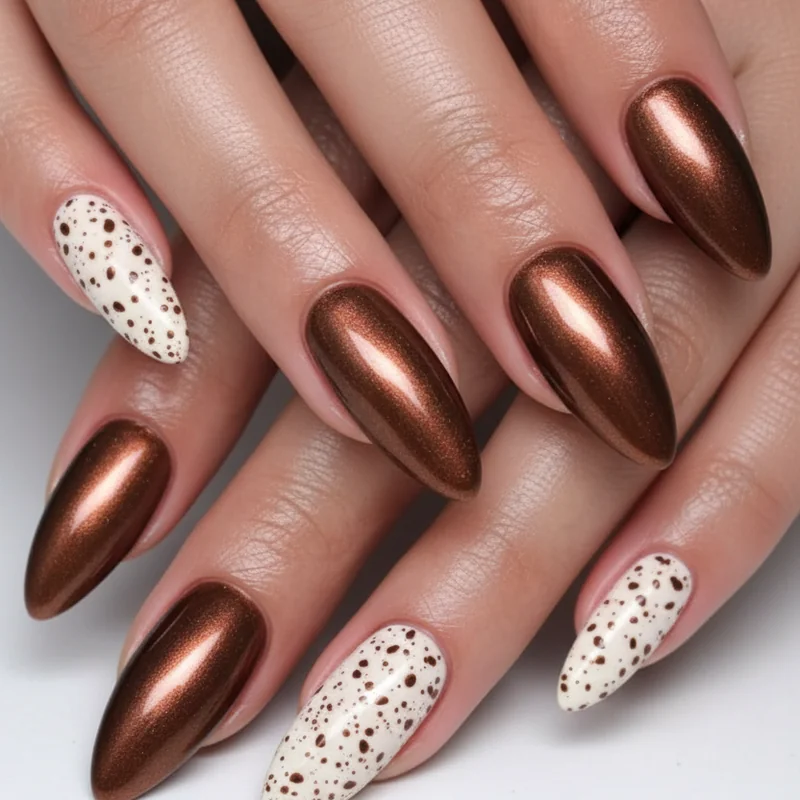
The cat-eye shimmer overlay. A duochrome or cat-eye magnetic polish layered over the fawn base gives the speckles dimensional depth. The shimmer catches differently depending on the light, which means the nails read differently every time you glance at them. This is the version for anyone who finds the original a touch muted.
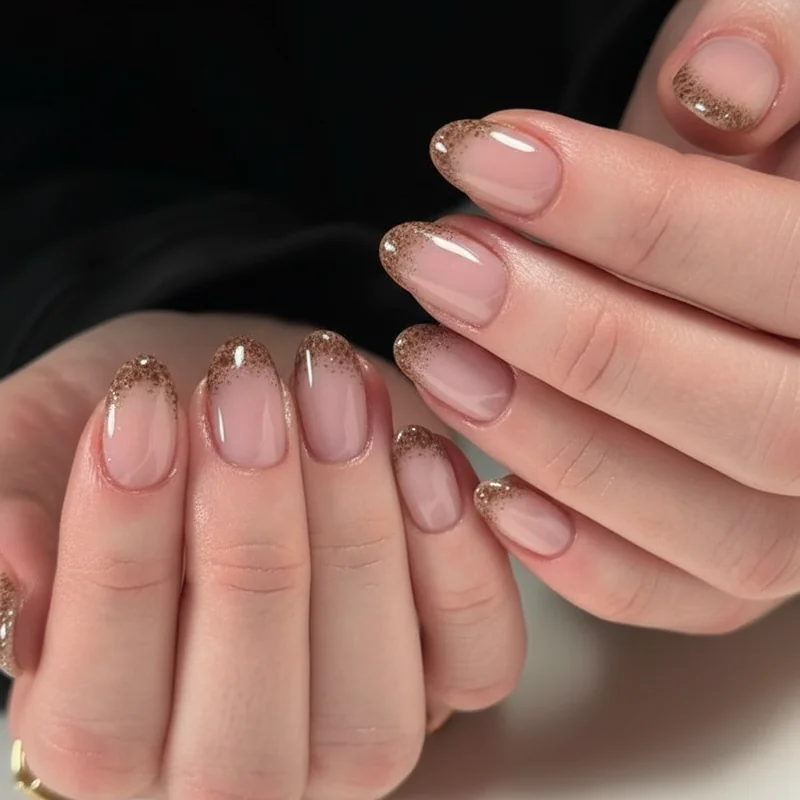
The bambi French tip. Fawn speckles placed only on the tip of the nail, with a clean or milky base beneath. Quiet, precise, and the most crossover-friendly variation. It reads as nail art to people who follow nail art, and as a slightly unusual French tip to everyone else.
The accent nail. Full set in a warm nude or clean caramel, with one or two nails in the full fawn print. The low-commitment entry point. Unexpectedly, also one of the more sophisticated outcomes, because the restraint does the work.
The chrome glaze finish. A chrome powder applied over the top coat gives the speckles a glass-like, almost wet look. Popular on TikTok, slightly trickier to execute at home, and genuinely striking in person.
The most wearable for everyday life is the accent nail or the bambi French tip. Both fit within professional settings without any explanation required. The full-set fawn print is the most visually committed and works best on almond-shaped nails, where the tapered tip gives the speckles room to spread naturally. These sit comfortably within the wider patterned nail moment covered in spring nail trends 2026.
The Colour Combinations Worth Trying (And How to Adapt Them for Your Skin Tone)
The brown-and-cream palette is not one thing. The gap between caramel with ivory and espresso with warm white is significant, both in terms of the finished look and in terms of which skin tones each combination serves best.
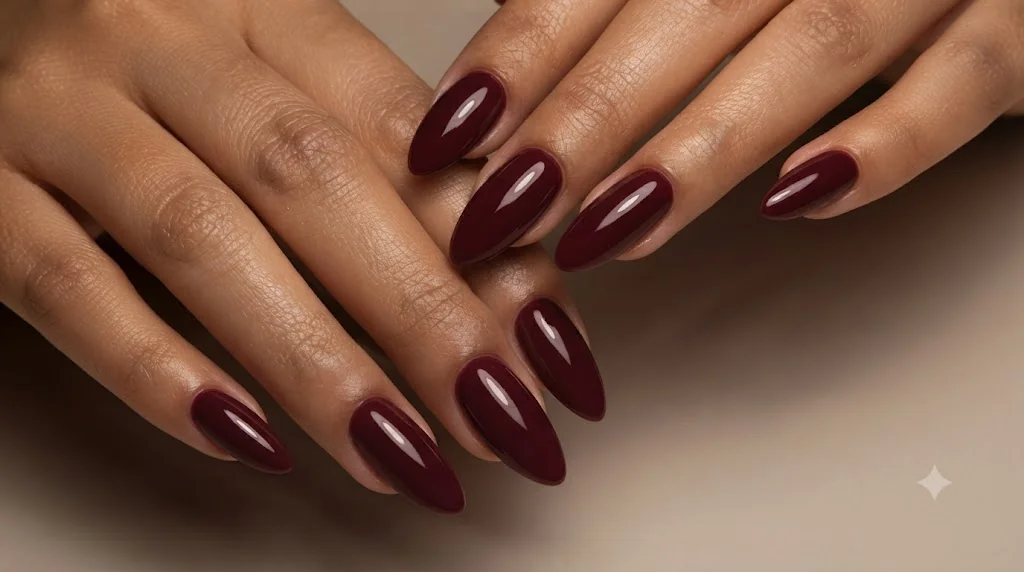
The standard bambi palette (coffee or caramel base, cream or sheer-white speckles) genuinely is flattering across a wide range of skin tones. But "universally flattering" obscures a more useful conversation. On lighter skin tones, the caramel base reads warm and sun-kissed; the speckles are visible without being high-contrast. On medium and olive skin tones, a deeper toffee or warm chestnut base reads richer against the skin, and ivory speckles stand out with more presence. On darker skin tones, the most effective version shifts the base toward espresso or deep tawny brown. The contrast between base and speckle is higher, which means the fawn pattern reads with clarity rather than disappearing into the nail.
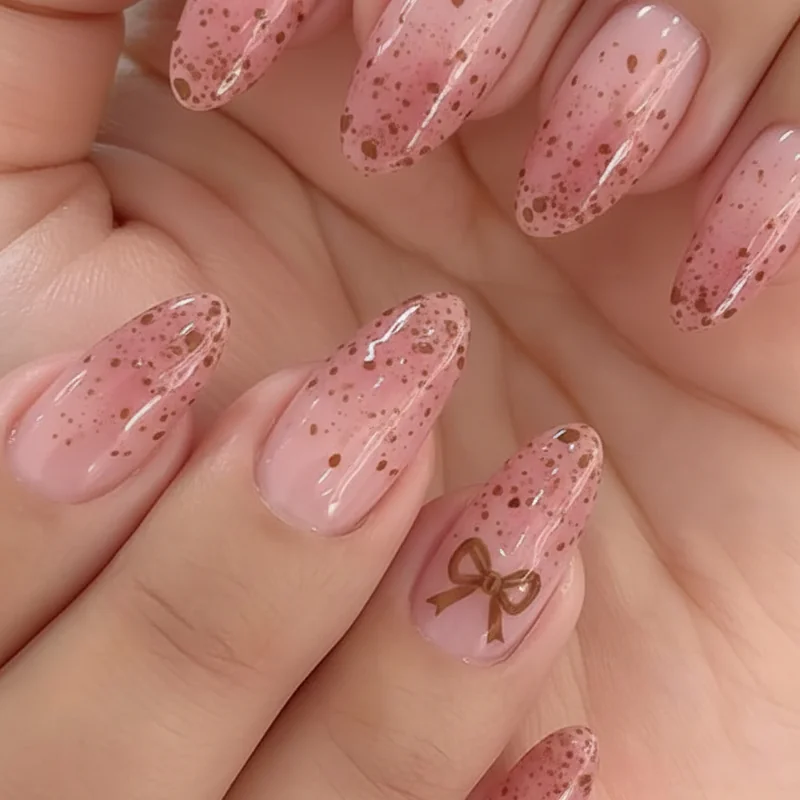
A note on sheer bases: some versions of the bambi manicure use a translucent brown, which gives the nail a softer, more diffused look. On very fair skin this can feel washed out. On medium-to-deep skin tones, a sheer brown base over the natural nail often produces a subtle, particularly elegant result.
Colour combinations worth trying:
- Toffee base, gold-toned speckles. Warmer and more autumnal. Works particularly well on medium and deeper skin tones where gold reads richer than ivory.
- Warm nude base, darker brown speckles. An inversion of the standard palette. The speckles are darker than the base, making the design more graphic, less fawn, but still within the bambi nail aesthetic.
- Dusty rose base, tawny speckles. Softer and more romantic. The fawn print takes on a doe-eye quality that pairs well with the coquette crossover moment.
- Metallic copper base, cream speckles. Statement version. The speckles glow against the copper. Not everyday, but genuinely beautiful for an occasion.
Bambi Nails on Short Nails: Does It Actually Work?
The fawn speckle is not a large motif. That is its entire advantage on short nails.
Leopard print on a short nail competes with itself. The pattern needs space to breathe and read as pattern. Bambi nails do not have that problem. The speckles are small enough to cluster naturally even on a nail with minimal surface area, and the technique is loose enough that there is no hard-edged repeat pattern to look cut off or incomplete. A short nail in warm brown with three or four cream dots in a soft cluster looks intentional. It does not look like a longer design that ran out of room.
What to adjust for short nails: scale back the dot size slightly and reduce the cluster count to two or three groupings rather than a scattered-all-over approach. The accent nail route is particularly strong here: one nail in full fawn print, the rest in the warm brown base, reads as deliberate and modern rather than a compromise. If you want the full-set effect, the oval or soft square shape frames the speckles better on shorter lengths than a straight square edge would.
The bambi French tip is the other strong option for short nails. A cream or sheer-white French with a few fawn speckles placed just at the tip keeps the design tight and contained, which is always the challenge with nail art on shorter lengths. Pair it with an almond shape, even a short almond, and the tip tapers in a way that makes the speckle cluster look considered. For more short nail shape advice, the almond nails 2026 roundup has the visual references you need.
The Bambi French Tip: The Understated Version That Goes With Everything
Most French tips are defined by a clean white edge. The bambi French tip redraws that line, literally. The tip zone becomes the canvas for the fawn speckle rather than a solid band of colour. The result is a French tip with depth and texture, without any of the drama of a full nail design.
The construction is simple: a clean or milky base coat, then fawn speckles concentrated at the free edge and slightly below it, softening out as they approach the midpoint of the nail. There is no hard line where the pattern stops. The speckles thin out naturally, which is what makes it read as a French tip rather than just dots on the top half of the nail. A clear or slightly tinted top coat holds everything.
This is the variation that travels. Office meeting, dinner with friends, a weekend away: the bambi French tip does not require explanation or contextualisation. It reads as beautiful nails. If someone leans in, they notice the speckles. If they do not, it reads as an interesting nude tip. That versatility is rare in nail art, and it is why this particular variation has the most longevity of everything within the bambi nail trend.
The French tip also solves the sophistication concern that many people bring to this trend. The worry is that fawn speckles tip into territory that is too cute or too whimsical. The French tip format contains that whimsy. It gives the print a structural frame. It is bambi nails for someone who would ordinarily choose a precise gel manicure over nail art.
How to Make Bambi Nails Look Expensive, Not Costume-y
The question this audience is actually asking, and that no other post has been willing to answer directly: yes, bambi nails can look costume-y. Here is exactly what causes it, and how to avoid it.
The base colour. Warm brown that reads orange is the most common mistake. You want toffee, caffe, chestnut: not terracotta. If the base reads warm but stays in the brown family, you are in safe territory. If it edges toward rust or orange, it pulls the whole look into craft-project territory rather than editorial.
The speckle size and consistency. Dots that are uniform in size and evenly spaced look like polka dots with ambition. The fawn speckle works because it is irregular: clusters of varying sizes, grouped loosely rather than distributed. Three or four dots close together, then nothing, then two dots, then a cluster of five. That randomness is the technique. A slightly sheer white or cream gives the speckles a soft edge rather than a hard circle, which is the visual detail that separates organic fawn texture from a craft sticker sheet.
The finish. A high-gloss top coat on a bambi nail reads polished. A matte top coat reads artistic. Both are valid, but both are intentional choices. Where nails look unfinished is in the middle: a finish that is neither glossy nor matte, but slightly streaky. Apply top coat in thin, even strokes and cap the free edge.
The shape. Stiletto bambi nails exist and they are beautiful on the right hand. But the shape that does the most work for the bambi print, making it look considered rather than quirky, is almond. The gentle taper gives the speckles a natural focal point and prevents the print from looking like it had nowhere to go.