Cinco de Mayo nails done right have almost nothing in common with what most nail posts show you. The red-white-green stripe set that dominates every search result is fine. It is also the least interesting thing you could do with one of the most visually rich cultural traditions in the world.
Mexico's visual culture is extraordinary: serape textiles, papel picado banners, Talavera pottery, Otomi embroidery, marigold garlands. It deserves more than a quick colour block. This post covers 12 Cinco de Mayo nail designs grounded in real Mexican art and craft, organised from the most approachable to the most intricate. Every design comes with honest guidance on what it takes to achieve it. Some are doable at home with regular polish in 20 minutes. Others are worth a salon booking and a reference image. All of them look genuinely beautiful.
One thing worth knowing before we start: Cinco de Mayo is not Mexico's Independence Day. It commemorates Mexico's unlikely military victory over French forces at the Battle of Puebla on 5 May 1862. Mexican Independence Day falls on 16 September. The celebration grew from Mexican-American communities in the US using it as a moment of cultural pride. That context matters because these designs are rooted in something real, and they look better when you know what they reference.
Why These Cinco de Mayo Nail Designs Go Beyond the Obvious
The problem with every competitor post on Cinco de Mayo nail ideas is not the designs. It is the absence of any reason to care about them. Forty images of red-white-green stripes with captions like "so festive!" tell you nothing useful and give you no sense of what you are actually celebrating.
Mexican visual culture is not a palette. It is a set of distinct craft traditions, each with its own history, its own region, its own vocabulary of shapes and colours. Papel picado comes from the folk art of cut tissue paper used to decorate for festivals and Day of the Dead altars. Talavera is tin-glazed pottery from Puebla, UNESCO-recognised, with a history dating to the 16th century. Serape textiles carry patterns traced back to indigenous Tlaxcalan weavers and the Saltillo region of northern Mexico. Otomi embroidery originates with the indigenous Otomi people of Hidalgo state.
When you put any of these on your nails, you are wearing a distillation of something that took centuries to develop. That makes the design more meaningful and, frankly, more beautiful. An Otomi-inspired set with tiny deer, birds, and flowers on a cream base is not a novelty nail. It is wearable folk art. The distinction matters, and it shows.
Mexican Flag Nails: The Classic Done Right
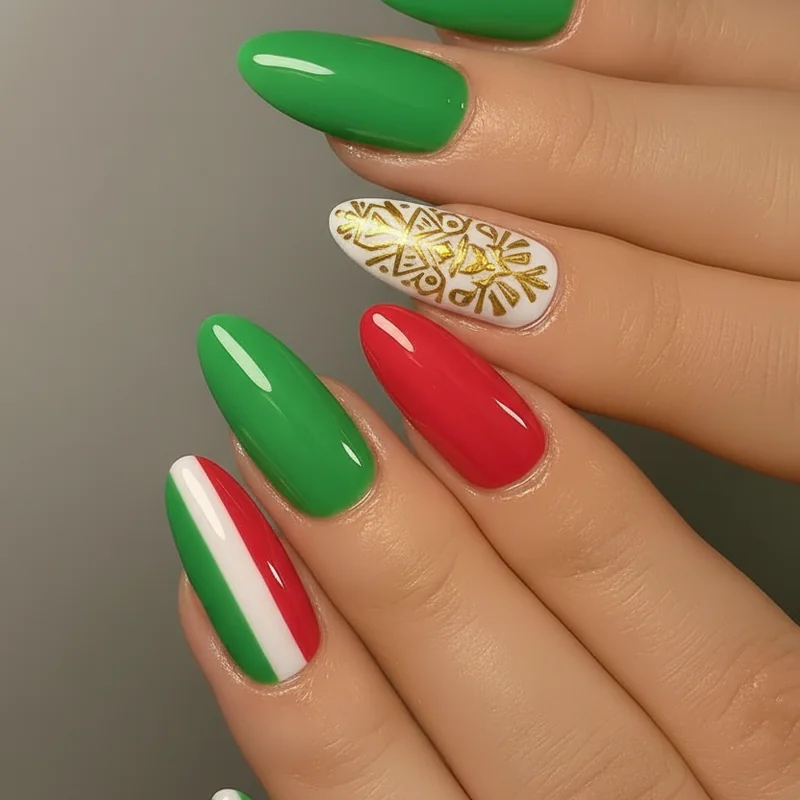
Three stripes does not make a Mexican flag manicure. The colour distribution is everything.
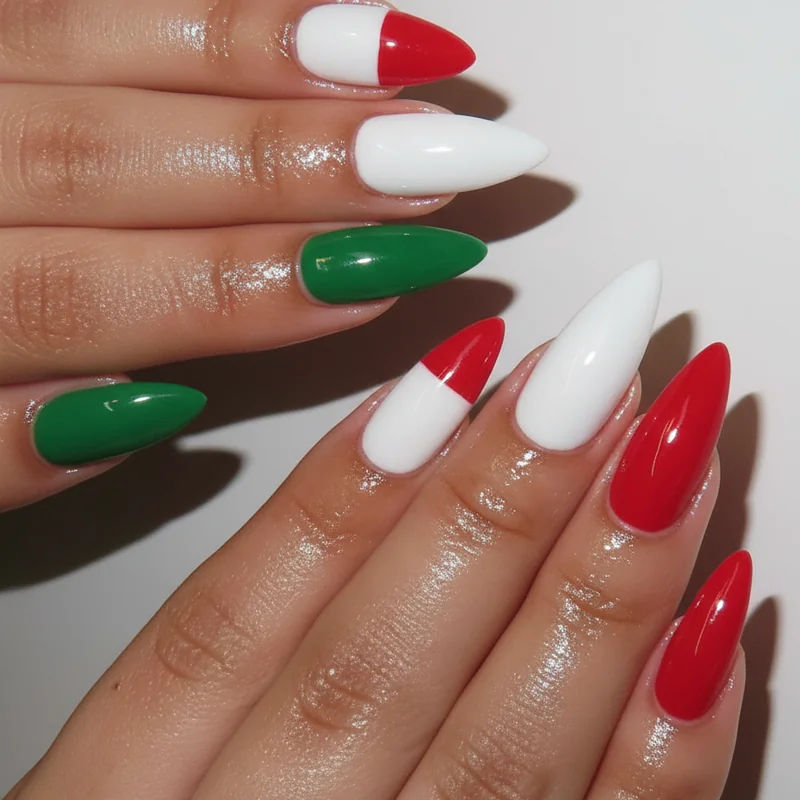
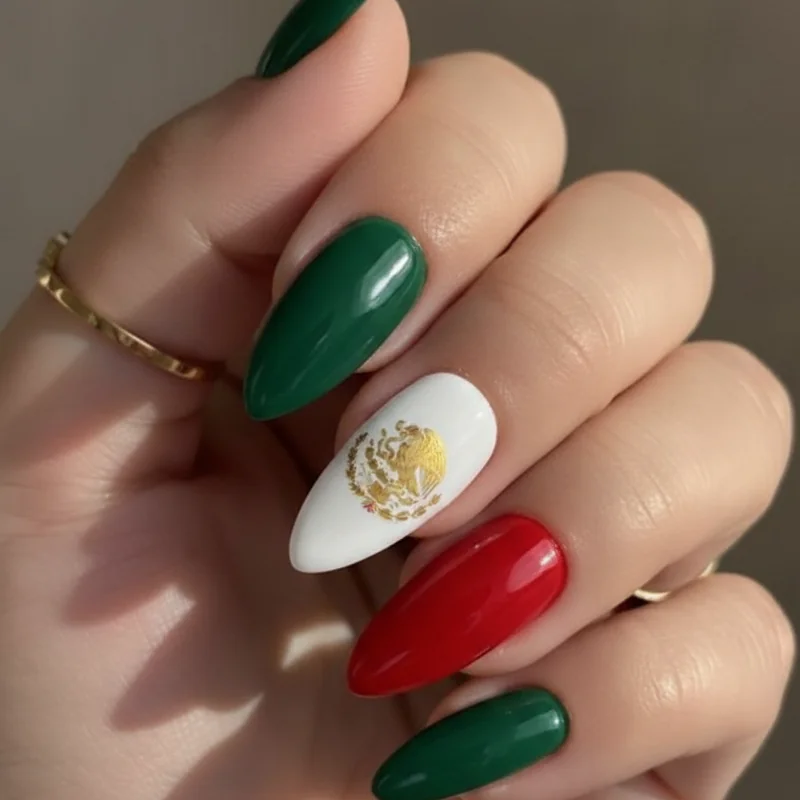
The Mexican flag palette of green, white, and red is perfectly considered, and on nails it earns its place when you treat it with a little restraint. The classic approach is a colour block: one finger green, one white, one red, repeated across both hands. For a more refined interpretation, try a French tip variation in the flag palette. Use a nude or sheer base with a coloured tip in deep forest green or brick red. This is exactly where the coloured-tip French manicure trend lands for 2026, and it reads far more considered than a straight stripe.
For those who want the full flag: start with a white base coat, apply a rich hunter green on the index and pinky fingers, deep scarlet on the ring and thumb, and keep the middle finger white. Add a single tiny gold detail on the white nail, a simple dot or a rough suggestion of the eagle motif, and you have a Mexican flag nail design that looks intentional rather than rushed.
At home difficulty: Very achievable with standard polish. No tools required.
Short nail friendly: Yes, completely.
Serape Stripe Nails: The Easiest Festive Manicure You Can Do at Home
Most people avoid serape stripe nails because they assume they need a striping brush. You do not.
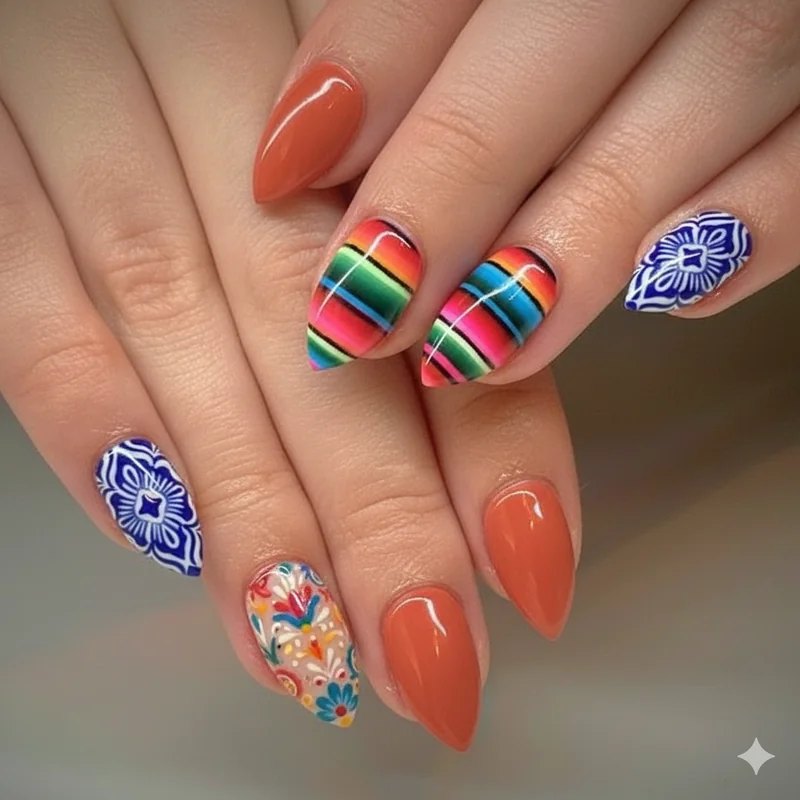
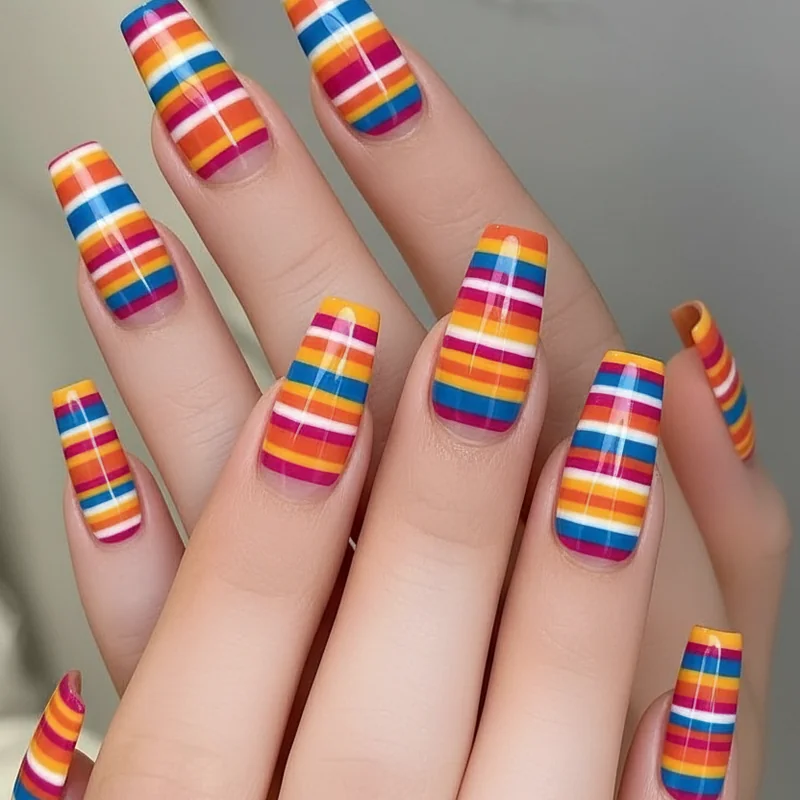
The serape is a rectangular woven blanket most associated with Saltillo in northern Mexico, defined by layered horizontal stripes in saturated, contrasting colours: saffron yellow, terracotta, cobalt blue, deep magenta, warm orange, and white. The original Saltillo serape features a central diamond motif, but the stripe pattern alone translates beautifully to nails and is achievable with nothing more than nail tape.
The technique: apply a base coat in deep terracotta or warm ochre and let it dry completely. Lay thin strips of nail tape horizontally at varied intervals, some close together and some further apart. The beauty of serape is that the spacing is irregular, not mechanical. Paint alternating colours across each section: magenta, then white, then cobalt, then saffron. Remove the tape while the polish is still slightly wet, then finish with a glossy top coat.
How do you get the serape stripe effect without a striping brush? This is exactly the method. Nail tape at irregular intervals, two or three colours applied quickly, top coat to seal. The result is unmistakably serape and takes less than 30 minutes once you have your colours laid out.
At home difficulty: Accessible with nail tape.
Short nail friendly: Yes. The horizontal stripe pattern actually suits shorter nail lengths particularly well.
Papel Picado Nails: The Most Beautiful Design Most People Have Never Tried
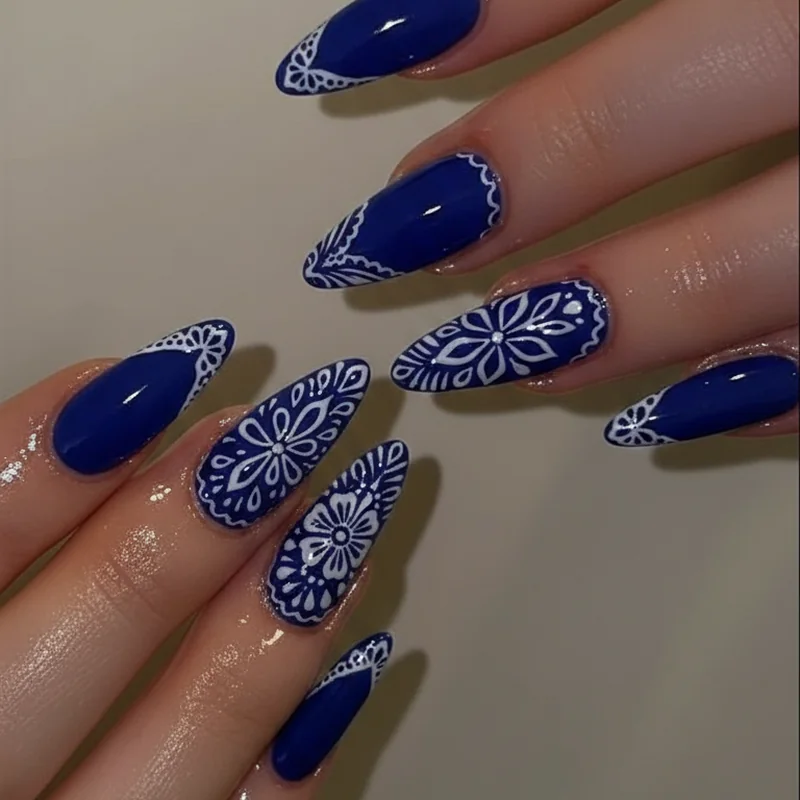
The name is not widely known, but the image is immediately familiar: those delicate banners of cut tissue paper strung above streets and altars during Mexican celebrations, their lacy patterns letting the light through.
Papel picado, meaning "perforated paper," is a traditional Mexican folk art made by cutting intricate designs from stacked tissue paper. The designs typically feature birds, flowers, geometric borders, and skeleton figures. They are displayed at Día de los Muertos, Fiestas Patrias, weddings, and quinceañeras. The visual signature of papel picado is its quality of negative space: the pattern exists in what has been removed, not what remains.
On nails, papel picado translates as a white or cream base with fine black linework suggesting the cut-paper pattern: geometric borders, a central floral or bird motif, openwork triangles along the tip edge. The result looks intricate, but a steady hand and a fine detailing brush are all it requires. You are not painting detail so much as sketching the suggestion of it.
For a more striking interpretation, use a deep jewel-toned base in cobalt blue, deep magenta, or rich teal, and work the linework in white or gold. The contrast lifts the design to something genuinely show-stopping. Nail artists like Ashley Biasella have documented their approach to papel picado nail art as a celebration of Mexican heritage. For further reading on the technique from an industry perspective, NAILS Magazine covers papel picado technique in detail.
At home difficulty: Moderate. Achievable with a fine detailing brush and patience.
Short nail friendly: Yes. The border and central motif scale to any nail length.
Mexican Floral Nails: Marigolds, Dahlias, and the Full Bloom
Not every floral is a Cinco de Mayo floral. The specific flowers matter.
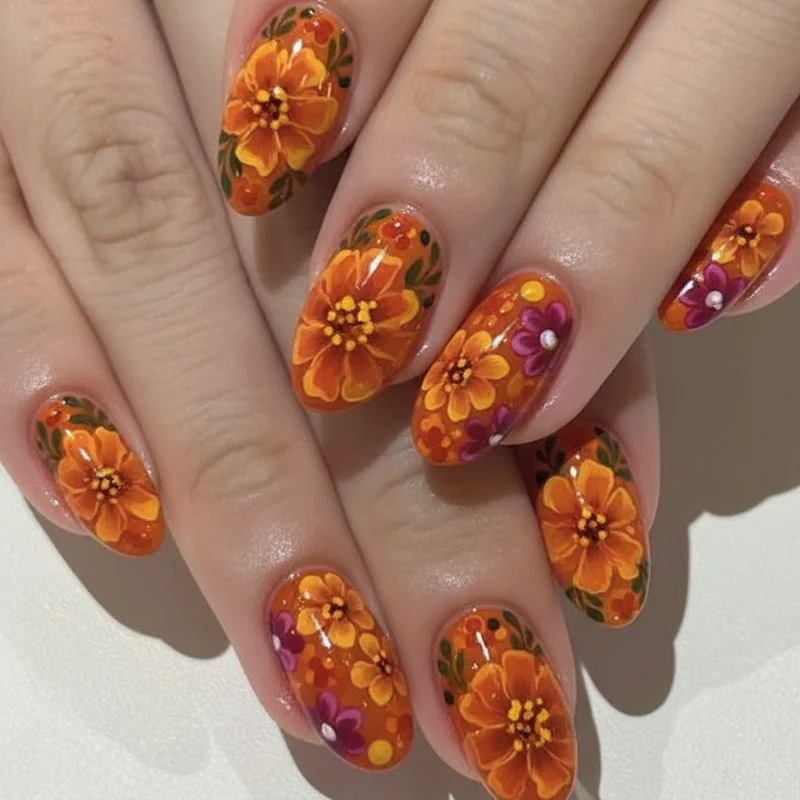
Two blooms are central to Mexican visual culture. The cempasúchil, the marigold, is the flower of Día de los Muertos, used to guide spirits to altars with its scent and saturated amber-orange colour. It appears in garlands, in painted tiles, and in embroidery throughout the country's craft traditions. The dahlia is Mexico's national flower, a native bloom that grows in the highland valleys and appears in textile and craft motifs in deep purple, orange, and red. Both translate to nail art in completely different ways.
A marigold accent nail sits beautifully on a terracotta, rust, or deep amber base. The petals are small and layered, which means a dotting tool and a thin brush are sufficient. You do not need elaborate technique. The marigold's charm is in its density of petals, which you can suggest with overlapping orange-to-yellow dots arranged in a rough circle. On one or two accent nails against a solid colour set, it grounds the whole manicure in something specific and real. If you want deeper floral nail guidance beyond the Cinco de Mayo context, this design connects directly to the broader spring floral nail landscape.
Dahlia nails call for more precision. The flower has a geometric petal symmetry that suits gel nail art well. Deep magenta or purple petals arranged around a gold or white centre, on a black or deep navy base, read as something closer to floral fine art than party decoration.
What flowers are traditionally associated with Mexican nail art? The marigold and the dahlia carry the most cultural weight, but roses, hibiscus, and agave-inspired geometric leaf motifs also appear regularly in Mexican textile and craft traditions.
At home difficulty: Marigold accent: achievable with a dotting tool. Full dahlia: easier with gel and a fine brush.
Short nail friendly: Accent versions suit any length. Full bloom suits medium to longer nails.
Talavera Tile Nails: The Art Collector's Take on Cinco de Mayo
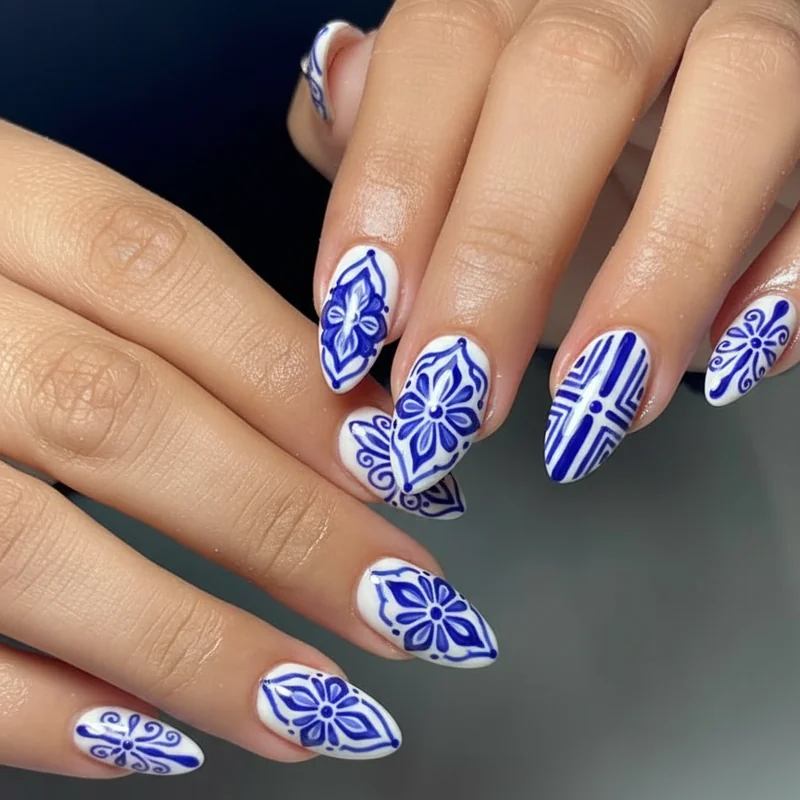
Cobalt blue on white. That is the visual signature of authentic Talavera pottery, and it is one of the most arresting combinations you can wear on your nails.
Talavera is a tin-glazed earthenware tradition from Puebla, Mexico. Its history traces to the 16th century when the technique arrived with Spanish colonists and merged with indigenous craft, and in 2019 it was added to UNESCO's list of Intangible Cultural Heritage of Humanity. The tradition produces tiles, vases, and vessels with a distinctive white base and hand-painted designs in cobalt, black, yellow, green, and terracotta. The motifs include stylised leaves, flowers, birds, and geometric borders: the kind of intricate, repeated patterning that looks extraordinary at nail scale.
On nails, Talavera translates as a white or off-white base with cobalt blue hand-painted detail. A central stylised flower, leaf borders along the sides, small geometric dots. The negative space is as important as the painted motif. For a restrained interpretation, a single Talavera-inspired accent nail on an otherwise clean white set is enough to make the whole manicure feel considered. A full hand of Talavera work, every nail carrying a slightly different traditional motif, is the kind of Cinco de Mayo nail design that earns genuine reactions.
What is Talavera tile nail art? It is the application of Puebla pottery's characteristic white-and-cobalt motifs to nails: geometric borders, stylised florals, and hand-painted linework that reference one of Mexico's most significant craft traditions. For broader context on Mexican textile and craft nail designs, the connection between Talavera and Otomi work runs deeper than aesthetic similarity alone.
The precision required for authentic-looking cobalt linework is beyond most at-home attempts. Book a nail tech appointment, bring reference images of actual Talavera tiles rather than nail art interpretations, and let a skilled artist work from the source.
At home difficulty: Advanced. Best suited to a nail tech appointment with clear visual references.
Short nail friendly: Yes. The Talavera border and central motif scale to any nail shape or length.
Otomi Embroidery Nails: The Design That Will Stop the Scroll
Nobody is doing this. That is precisely why you should.
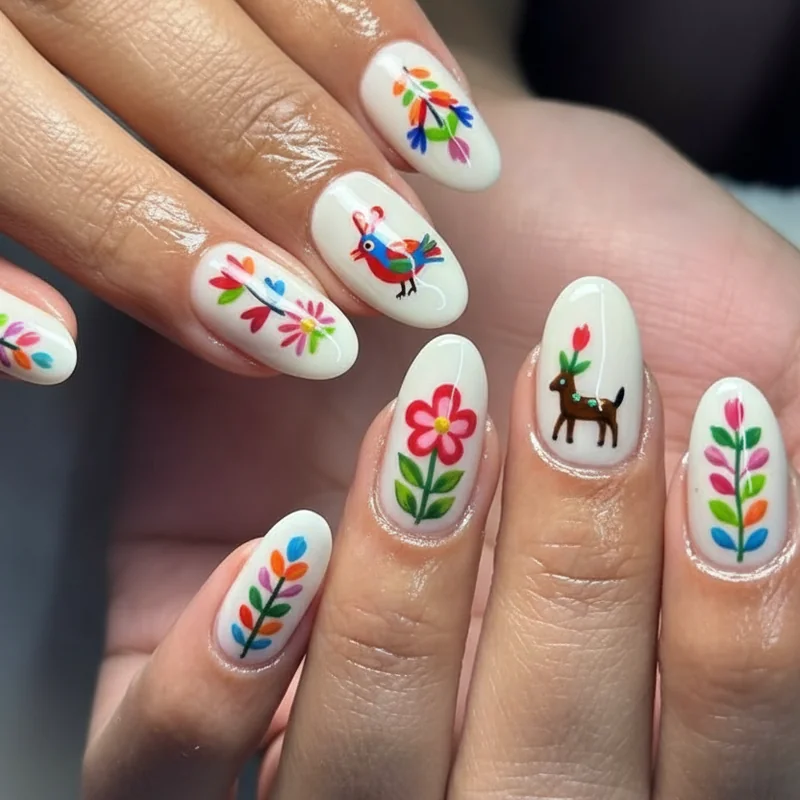
Otomi embroidery originates with the indigenous Otomi people of Hidalgo state in central Mexico. The modern form, called tenango after the municipality of Tenango de Doria where it is primarily produced, developed in the 1960s and is characterised by dense, colourful hand-stitched motifs of animals, birds, flowers, and abstract figures on white or cream cloth. The visual quality is unmistakable: bold outlines, flat colour fills, a sense of joyful abundance without hierarchy. Deer, flowers, and serpents share space with equal visual weight. It is the kind of pattern that rewards a long look.
On nails, Otomi embroidery translates to a nude or cream base with small painted motifs in coral, turquoise, yellow, and black: a tiny deer on the thumb, a small bird on the index finger, a circular flower on the middle nail. The outlines are bold relative to the fill, and that is the visual characteristic that makes it read as Otomi rather than generic floral. The result is a Cinco de Mayo nail set that looks unlike anything else at the celebration.
What is Otomi embroidery and how does it translate to nail art? Otomi, or tenango, embroidery is a hand-stitch tradition from Hidalgo, Mexico, featuring dense colourful motifs of animals and flowers on white cloth. On nails, it appears as small hand-painted figures with bold outlines on a nude or cream base, with each nail carrying a different motif from the traditional Otomi visual vocabulary.
At home difficulty: Moderate to advanced. A thin detailing brush and a steady hand are all that is needed. The motifs are small enough that imperfect outlines read as charming rather than imprecise.
Short nail friendly: Yes. Individual motifs scale beautifully to shorter nails.
Cactus and Chilli Accent Nails: Playful Without Being Costume-y
There is a version of cactus nails that looks like a novelty set from a party shop, and there is a version that looks genuinely charming. The difference is the base.
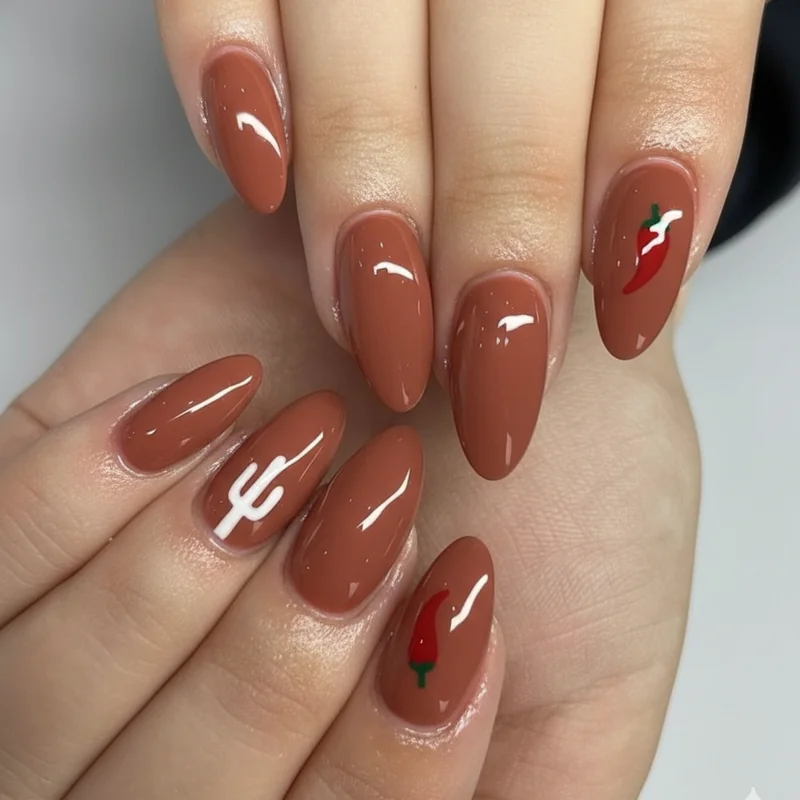
A deep forest green or terracotta base with a single small cactus in white or sage green outline on the accent nail reads as considered nail art. That same cactus on a bright lime green base next to a sombrero reads as a costume. The motif itself is not the problem. The problem is context.
Cactus nail art works best as a single accent on an otherwise refined set. Pair it with a serape stripe design: two fingers carry the stripe palette, one finger carries a small cactus silhouette in white or ivory. The combination is playful, the cultural reference is real, and nothing about it tips into caricature. A chilli pepper accent works on the same principle: one deep red nail with a tiny painted chilli in vivid scarlet and green, set against a dark or neutral base on the remaining fingers.
Can you do Cinco de Mayo nails at home without nail art tools? Yes, and this is the cleanest example. A solid base in your chosen colour, one simple accent shape drawn with a fine brush or a toothpick loaded with contrasting polish, and the rest of the nails left solid. Unfussy, fast, and recognisable as intentional.
At home difficulty: Easy. The simplest festive option after a plain colour block.
Short nail friendly: Completely.