Meet Jeff Pink: The Man Behind the French Manicure
The answer to who invented the french manicure is Jeff Pink, founder of Orly International, a professional nail brand still in business today. Pink developed the design in 1975 while running a Hollywood beauty supply store that served film studios directly. He is the person the nail industry credits as the inventor of the modern French manicure, decades of retellings and one competing claim notwithstanding.
Before Orly existed as the brand nail technicians recognise now, it was Pink's answer to a problem nobody else in the beauty supply business had bothered to solve. He was not a trained manicurist chasing an artistic breakthrough. He was a supplier who watched Hollywood studios burn through time and money on a fixable inconvenience, and he built a product to fix it. In his own words, the idea traces directly to that studio floor.
Orly International is the company Pink founded off the back of that invention, and it remains active in the professional nail industry today, still selling the Original French Manicure line under his name. This is not a lost founder or a company that vanished after one product. Pink kept building the business for fifty years, which is part of why the nail industry has never seriously entertained crediting anyone else with the modern version.
The Hollywood Problem That Started It All
Studios were losing money over fingernails. It sounds absurd until you see the arithmetic Pink saw daily: an actress changes costume for a new scene, and the nail polish from the last outfit no longer matches. A manicurist gets called back to redo the colour, every time, for every actress, on every production day.
Pink was running a beauty supply store that serviced Hollywood film sets through the mid-1970s, close enough to the industry to hear directors complain about exactly this. One director pushed him for a fix, a single nail look that would work with any wardrobe change, so studios would stop paying for constant repaints between takes. That request is the entire origin of the French manicure. Not fashion. Not art direction. A cost-control problem on a film set.
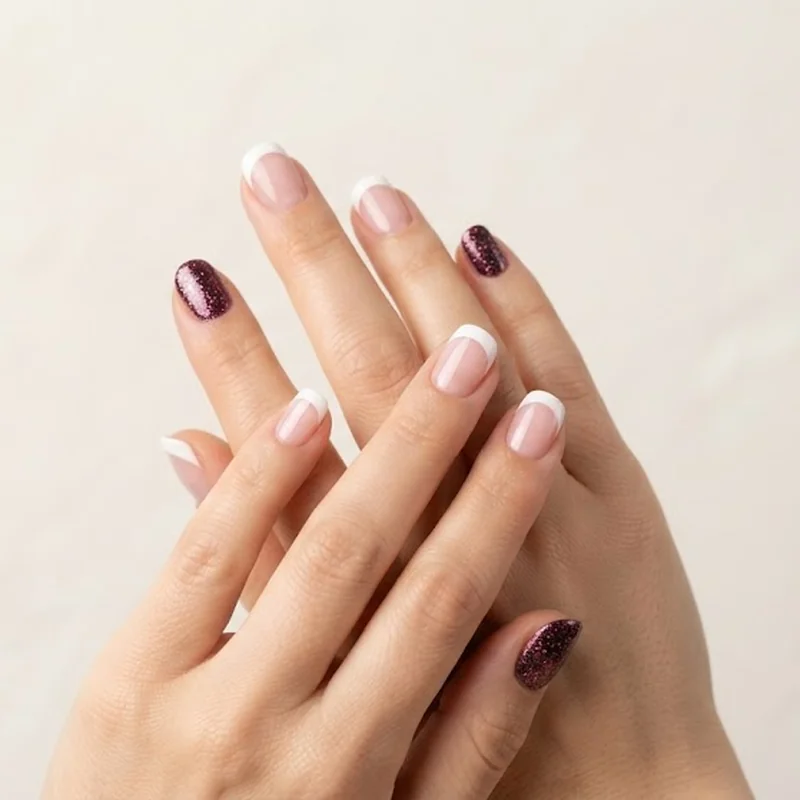
Pink's solution came from an old trick he had seen before, women using a white pencil under the nail tip to brighten it. He wanted something bolder and more permanent, so he called his polish supplier and asked for a gallon of white nail polish, a colour nobody was manufacturing in bulk because nobody wore it. The supplier reportedly asked him who on earth would wear that. Pink applied the white tip over a sheer, flesh-toned base and brought it to the director. It worked with every costume, every scene, every time. That is the moment the modern French manicure was born, years before it had the name everyone now recognises.
How the "Natural Look" Became the French Manicure
The name almost was not French at all. Pink's original label for the design was flatly descriptive: the Natural Nail Look, sold to salons and studios as the Natural Look Nail Kit. It said exactly what it did and nothing more, which is precisely why it never had a chance of becoming iconic.
The Natural Look Nail Kit was the first commercial packaging of Pink's design, marketed as a professional product for achieving the white-tip, nude-base finish he had built for Hollywood studios. It sold on function, not romance, and for a while that was enough. Salons picked it up because it worked, not because of what it was called.
The rename happened almost by accident. A friend invited Pink to Paris for a round of fashion week catwalk shows, and he brought the Natural Look with him, applying it on models backstage between outfit changes just as he had for actresses in Los Angeles. Designers and stylists loved it on the runway. On the flight home, Pink found himself thinking the name was accurate but forgettable, too clinical for something this simple to catch on. Paris was the last place he had shown it, so French manicure became the name, chosen for how it sounded rather than where the idea began. Orly's own account of the story confirms the same sequence: the design came first, and the name arrived almost as an afterthought on the return flight.
Wait - Did Max Factor Invent It First?
There is a competing claim, and it deserves a direct answer rather than a shrug. Max Factor, the cosmetics brand built by the man who coined the word "makeup" for Hollywood film, sold a white-tip nail product decades before Jeff Pink ever opened his beauty supply store, which is why some sources credit Max Factor as the true originator instead.
In the late 1920s and through the 1930s, Max Factor marketed a product called Society Nail White, a white liquid applied under the nail tip, paired with a rose-toned Society Nail Tint for the rest of the nail. Buffed together, the finished effect closely resembles today's French manicure, predating Pink's version by roughly four decades. That timeline is well documented and not in dispute.
What is missing from the Max Factor claim is everything that makes the French manicure the specific thing people search for today. There is no record of Max Factor ever calling the look a French manicure, taking it to Paris, or building it into a lasting commercial line the way Pink did with Orly. Max Factor's product came and went as one item in a much larger catalogue. Pink's version became the name, the naming story, and the brand that still sells it fifty years later. Nail industry trade publication NAILS Magazine acknowledges both claims while continuing to credit Pink as the inventor of the modern version. The visual idea has older roots. The invention people mean when they say "French manicure" belongs to Pink.