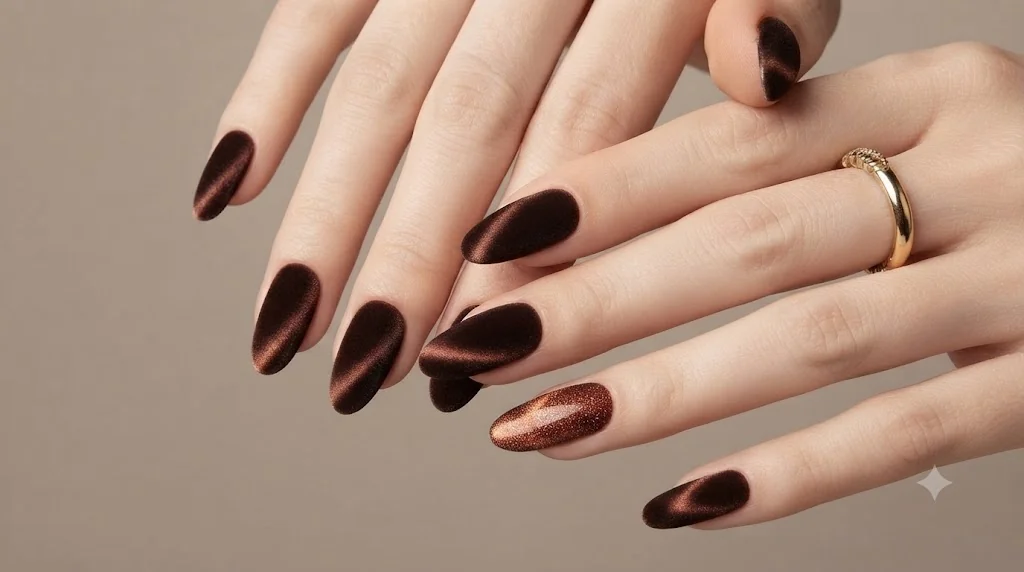
You are standing at the colour wall. There are two hundred bottles in front of you and you have been staring at them for four minutes. You feel something specific a restlessness, a softness, a low hum of wanting to mark this moment and you have no language for translating it into a shade. So you reach for the one you always reach for, book the appointment, and leave feeling like the nails are fine but somehow not quite right.
Nails by mood is what most people already do instinctively. The problem is they do it without a framework, which means they miss the mark about half the time. This guide is the framework. Nails by mood maps every major emotional state happy, heartbroken, confident, romantic, dark, calm, and everything in between to the specific colours, finishes, and aesthetics that actually deliver the feeling you are after. Keep it. Come back to it every time you book an appointment or reach for a polish.
A 2025 survey found that 68% of people directly link their nail colour to their current mood. The other 32% are leaving something on the table.

Do nail colours actually affect how you feel?
Yes and the research behind it is more substantial than most people expect. A 2025 colour psychology survey found that 68% of respondents directly link their nail colour choice to their current mood. Colour psychology research confirms that warm, saturated hues trigger dopamine responses, while cool, muted tones activate the parasympathetic nervous system and lower cortisol levels.
Colour psychology in beauty is the documented study of how pigment choices influence emotional states, self-perception, and the perceptions of others and it applies as directly to nail polish as it does to paint on a wall. The mechanism is not metaphorical. When light hits a saturated red, the brain processes it differently to a muted sage. The emotional response is neurological before it is aesthetic.
There is a second mechanism at work, too. Researchers call it enclothed cognition: the principle that intentional choices about appearance influence mood and behaviour more than incidental ones. Wearing a red nail because you deliberately chose it for how it makes you feel carries a different psychological weight than wearing it because it was the first bottle you grabbed. The act of choosing with intention is part of what makes the colour work.
This matters because it means nails by mood is not about superstition or aesthetics. It is about using a tool that is already in your hands, already part of your regular routine, with considerably more intention. Colour psychology research from multiple sources including the colour and dopamine dressing research from Semilac confirms that bright, saturated colours produce measurable positive emotional responses. Cool blues and greens measurably reduce physiological stress markers. Dark, deep tones signal authority to both the wearer and the people around them.
The question, then, is not whether nail colour affects how you feel. It does. The question is which colour to reach for, and when.

How to use this guide: what mood are you in right now?
Most nail colour guides ask the wrong question first. They open with the colour and tell you what emotion it represents. This guide starts with you.
Mood nails is the practice of choosing your nail colour intentionally based on how you feel or how you want to feel. Rather than picking what is trending or what you wore last time, you use colour psychology to select a shade that either mirrors your emotional state or helps shift it. It is one of the most personal forms of self-expression in beauty.
Before you read on, settle on one of two approaches. The first: choose a colour that reflects where you are right now the mirror approach. If you are heartbroken, you do not pretend otherwise. You choose something that holds that weight beautifully rather than fighting it with cheerful coral. The second: choose a colour for where you want to move the reset approach. You are anxious about a big week ahead, so you reach for confident red rather than the soft nude that matches your nerves. Both are valid. Both work differently.
At Mirellé, we consider the reset approach to be slightly more powerful, because it treats the manicure as an active tool rather than a passive record. But knowing which approach you are using on any given day makes the choice faster and the result more satisfying.
Here is the emotional map this guide covers. Find where you are or where you want to be and go straight to that section.