Sensory Nails vs. Gummy, Velvet & 3D Nails: What's the Difference?
Gummy nails are a technique. Sensory nails are a category, and the difference matters more than it sounds. Gummy nails are specifically that thick, jelly-like builder gel dome, translucent or saturated, built to look and feel like an object rather than a coat of colour. It is one entry on a much longer sensory list, not a synonym for it.
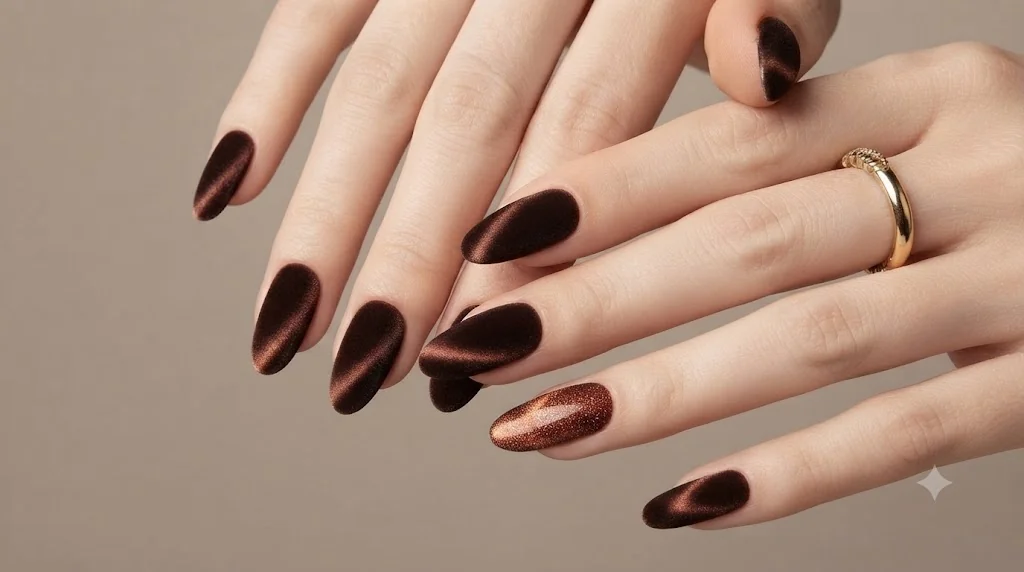
Velvet finishes belong on that list too, but they work opposite to a gummy dome. Where gummy nails add raised height, velvet powder flattens texture into a soft, matte, almost fabric-like grip. Both count as sensory. Neither is the whole story. And 3D nail art, the flowers, pearls, charms glued or sculpted onto the plate, is sensory only when the piece itself invites touch rather than just decorating the surface from a distance.
So when is something not a sensory nail? A glossy chrome finish is not, no matter how visually loud it gets, because there is nothing new to feel. A flat French tip is not. The line is tactile difference, not visual complexity. For the mechanics of the specific gummy technique, the full breakdown of gummy nails' rubberised 3D dome technique covers the dome build in detail, separate from the wider sensory umbrella this post defines.
Think of sensory nails as the genus and gummy, velvet, embossed, and rubberised finishes as species within it. Ask for "sensory nails" at a salon with no further detail and a good tech will ask which texture you mean, because the term itself does not specify one.
Why Sensory Nails Are Trending Into 2027
Beauty spent years chasing flatness. Clean girl minimalism, glazed donut gloss, milky soap nails, all of it rewarded looking effortless from a distance. Sensory nails are the direct counter-move, arriving right as that flatness starts to feel exhausted rather than aspirational.
The tactile pull showing up across 2026 nail trends already leans this way, with raised elements engineered specifically to look and feel dimensional rather than simply decorative. That same instinct is what pushed Pinterest to name rubberised nail art and 3D texture the tactile obsession of the year in its own trend forecasting, and sensory nails are the wider category that instinct belongs to, not a rebrand of it.
The pattern echoes well beyond nails. Bendy phone cases, elastic cheek tints, squishy everything, all reward touch over appearance, and manicures are catching up to a broader sensory-seeking mood in product design generally. Nails were always going to follow eventually. They are one of the few beauty categories a person interacts with physically, all day, without thinking about it.
Not every 2027 direction is chasing this same tactile instinct. Circus nails is pulling toward loud, maximalist visual chaos instead, and snail nails is leaning slow-beauty and understated. Sensory sits apart from both, defined by touch rather than volume or pace.
The Functional Side: Sensory Nails for Anxiety and Tactile Needs
Aesthetic sensory nails are one half of this. The other half searches with a completely different urgency, and gets almost nothing useful back. Can sensory nails help with anxiety or sensory processing needs? For some people, yes, in a limited sense. A deliberately textured nail surface, ridges, raised dots, a grippy matte grain, gives fidgeting fingers something to run over that is not another finger or the edge of a nail bed. It will not treat anxiety. It is not a clinical tool. But as a discreet, wearable texture to touch throughout the day, it fills a real gap that generic fidget jewellery does not, because it is already on the hand and does not read as a stim device to anyone else.
This audience has been searching in the wrong direction for years, landing on nail-biting stim rings and fidget keychains sold as anxiety tools, useful in their own right but disconnected entirely from actual nail art. Nobody had written the version that says: here is what to ask for, and here is how it looks finished, not just functional.
The request itself is simple once it has a name. A textured topcoat over a short, low-maintenance shape, raised in specific spots rather than uniformly smooth, gives a genuine tactile anchor without sacrificing a finished, salon-quality look. That is the version worth asking for by name, and it is exactly what "sensory nails" as a search term should have surfaced all along.
The Textures That Define the Sensory Nail Aesthetic
Matte builder gel is the baseline. It swaps gloss for a soft, chalky grip, the closest thing to suede a fingertip can find on a nail. Rubberised finishes go further, that springy, almost bouncy surface tension that reads as slightly softer than it actually is, a texture most people associate instinctively with the gummy nail dome, applied here in flatter or more subtle forms.
Embossed patterns are the more restrained end of the spectrum. A pressed grid, a raised line, a subtle ripple, all readable by touch before they register visually. And velvet powder finishes sit somewhere between matte and fabric, a texture Pinterest's own trend language has repeatedly tied to the jelly candy aesthetic without ever separating it into its own named category. For readers chasing that specific magnetic shimmer-meets-texture combination, the full guide to velvet and magnetic cat-eye finishes covers it directly.
Texture-forward nail art is not confined to one lane, either. Crochet nails takes the same dimensional instinct in a textile direction rather than a gel one, proof that tactile finishes are becoming their own broad movement across 2027, not a single technique wearing different names.
A tactile finish, in the strictest sense, is any surface engineered to feel different under the fingertip than a standard glossy or satin polish coat. That single definition covers everything above, and it is the one worth remembering when a nail tech asks what exactly you mean.