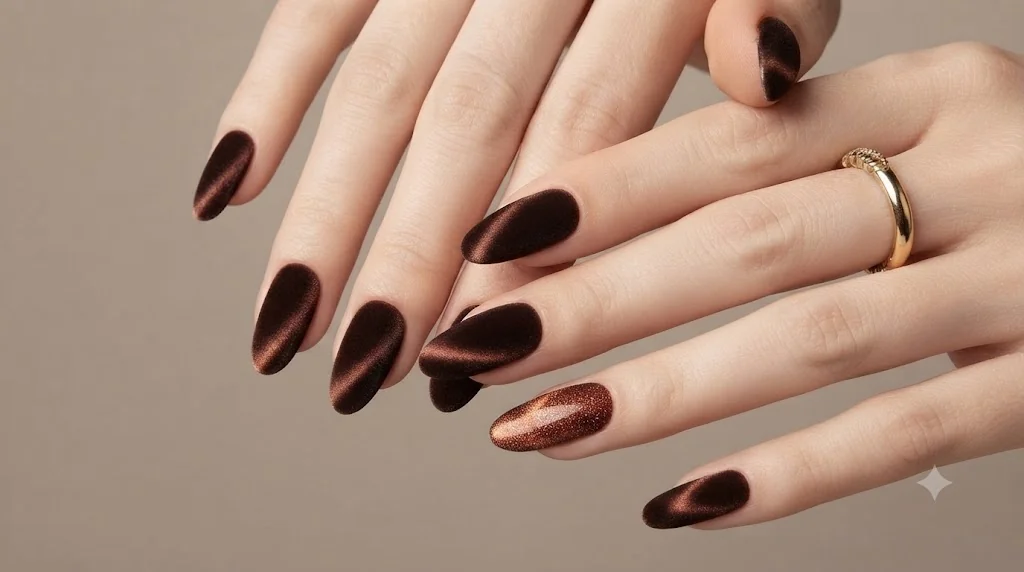
You have definitely seen this on your FYP. The thin beam of light running across the nail, shifting as the hand moves, somehow looking like a laser scan and a fine-art detail at the same time. That is barcode nails, and the fact that you are here means you already know you want them.
The trend arrived in the West via TikTok in late 2025, but Seoul nail studios had been refining it for a year before that. What separates a genuinely good guide to barcode nails from the dozen rushed trend reports already out there is everything that comes after "it's a horizontal cat eye" -- the colour strategy, the design spectrum, the shape suitability, the embellishment builds. That is exactly what this covers.
Whether you are booked for a salon appointment next week or figuring out whether your existing magnetic polish kit will do the job at home, you will leave here knowing precisely what to ask for, what to expect, and which direction suits you. If you are new to magnetic nail art and want a full introduction to the format this trend evolved from, Cat Eye Nails: Every Style, Color & Design Worth Trying in 2026 is the place to start.
What Are Barcode Nails -- and Why Does the Stripe Move When You Do?
One coat of magnetic gel polish. A rectangular neodymium magnet held horizontally across the nail for thirty seconds. That is the entire mechanism behind barcode nails.
What happens inside that thirty seconds is where it gets interesting. Magnetic gel contains metallic pigment particles suspended in the formula. When a magnet is held above the nail, those particles are pulled into alignment along the magnetic field. Hold a standard cat eye magnet diagonally and you get a diagonal sweep. Hold a rectangular magnet horizontally (thin edge facing upward, parallel to the nail tip) and the particles form a single fine horizontal beam. Nail artist Chloe Jeong describes the hold as positioning the magnet "along the nail bed" with the thin edge up; the particles respond by pulling into "a fine, linear formation." Cure the gel with the magnet still in place, and the line is locked in permanently.
The shifting quality -- the reason the stripe appears to travel up and down as your hand moves -- is built into that structure. Once cured, the aligned particles catch light at a specific angle. As your hand turns, the angle of incidence changes, and the shimmer line appears to migrate across the nail surface. It is the same phenomenon as a lens flare in photography: the light is not moving. Your relationship to it is.

The Korean Connection: Why Seoul Nail Studios Created This and the West Is Just Catching Up
Korean nail art has a specific philosophy that Western nail culture tends to underestimate. The goal is almost never bold colour or graphic pattern. It is light interaction -- the way a nail surface behaves as it moves through space.
The barcode format is a direct product of that thinking. Seoul studios were already pushing horizontal magnet holds as a more architectural, restrained alternative to the diagonal cat eye sweep well before the design reached Western feeds. Yoonsun Lee, a nail artist based in Yanguju, traces the textured-stripe aesthetic to Japanese influence but notes that Korean artists refined it into something more precise, more minimal, and more intentional. That refinement is visible in the Korean approach to colour: deep, saturated bases that maximise contrast with the metallic stripe, applied with an evenness and surface quality that makes the finish look almost engineered.
The West is catching up fast. As part of the broader 2026 magnetic nail moment covered in Cat Eye Nail Trends 2026: What's New, Viral & Next, the barcode format is crossing over from K-beauty-adjacent audiences to mainstream salon requests. Nail artist Yoshiko Yamaguchi, based in New York City, predicts the requests will accelerate sharply through the year. The vocabulary just needed a moment to arrive.