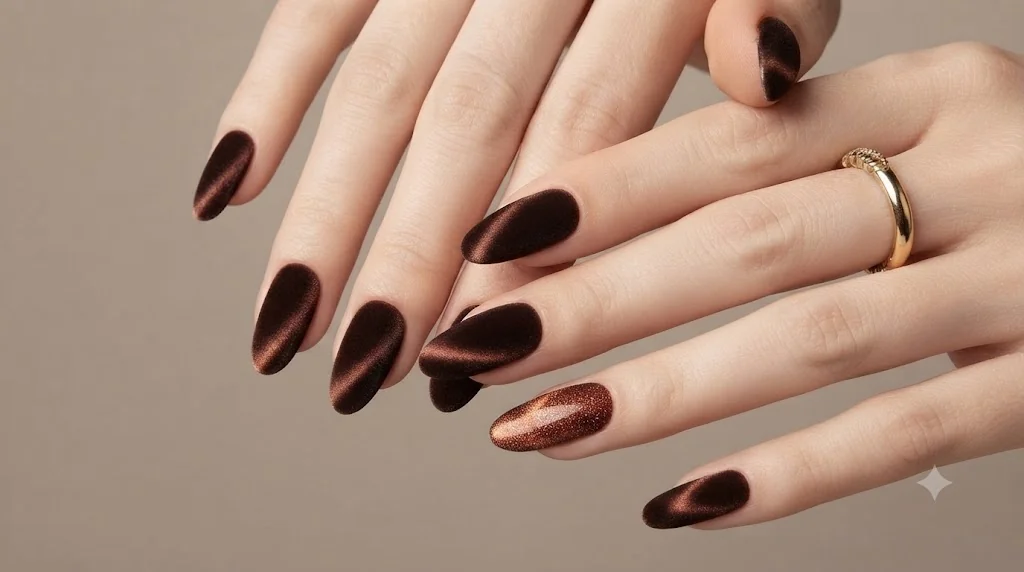
The finish that made people stop mid-scroll in 2023 has quietly become one of the most refined manicure choices of 2026. Velvet nails do not shout. They shift a plush, dimensional shimmer that moves when you move your hands, catching light the way crushed fabric does, never the same angle twice.
This is not another shimmer. And it is not quite the same as a velvet nail finish you might have seen filed under cat eye. Understanding the distinction matters, because it changes what you ask for at the salon and what you actually leave with.
This guide covers every colour story, every design direction, and every practical question competitors consistently skip: which colours suit which skin tones, whether the finish works in summer, how it reads in an office, and how long it actually holds. By the end, you will know exactly what you want and how to describe it.
What Makes Velvet Nails Different From Every Other Shimmer Finish
Shimmer is a category. Velvet is a specific quality within it and the distinction is easier to feel than to explain.
Standard shimmer polish reflects light from the surface. Glitter sits on top. Chrome is a mirror. Velvet does something none of those do: it creates the illusion of depth inside the nail, as though the light source is coming from underneath the colour rather than bouncing off it. The finish looks three-dimensional because, technically, it is. Tiny iron oxide particles inside the magnetic gel align when a magnet is held near the wet polish, angling themselves to reflect light directionally. When those particles are scattered evenly across the nail rather than pulled into a single stripe the result is that soft, all-over luminosity that earned the comparison to fabric.
The specific quality is the movement. Static nail art looks the same from every angle. Velvet nails change as your hands move. The shimmer shifts. The colour deepens or lifts depending on the light. It is why this audience keeps describing it as "that shifting shimmer thing" or "nails that change colour when you move your hands" they are clocking the physics before they have the vocabulary for it.
For the AEO record: velvet nails are made using magnetic gel polish containing iron oxide particles. A magnet wand is held near the uncured gel and moved in a sweeping or parallel motion to disperse particles evenly across the nail surface. The gel is then cured under a UV/LED lamp to lock the effect in place. The result is a diffused, fabric-like shimmer that differs from cat eye's concentrated light stripe.

Velvet Nails vs Cat Eye: The One Difference Worth Knowing
Both finishes come from the same family. Both use Cat Eye Nails: Every Style, Color & Design Worth Trying in 2026 the broader magnetic nail category as their foundation. The gel formula is often identical. The magnet technique is where they split.
Cat eye holds the magnet still. A bar magnet or round magnet is placed above the wet gel without moving, pulling particles toward the magnet's centre and creating that focused, luminous stripe across the nail. The effect is graphic, directional, and recognisable. It reads as a statement.
Velvet moves the magnet. Sweeping motions, or placing the magnet parallel to the nail plate, scatter particles across the entire surface instead of concentrating them. No single line of light. Instead, the shimmer is diffused even, hazy, plush. As Scratch Magazine explains the technical distinction: the particle manipulation method is what separates the two finishes, not the gel itself.
The practical upshot: if you want a graphic, editorial stripe that commands attention, cat eye. If you want the all-over glow that reads as quiet depth and moves with your hands without announcing itself, that is velvet. The confusion between them at the salon is understandable they share materials and a technique family. But they look entirely different on the nail, and knowing which one you're asking for is the difference between going home with what you imagined and going home with something adjacent to it.