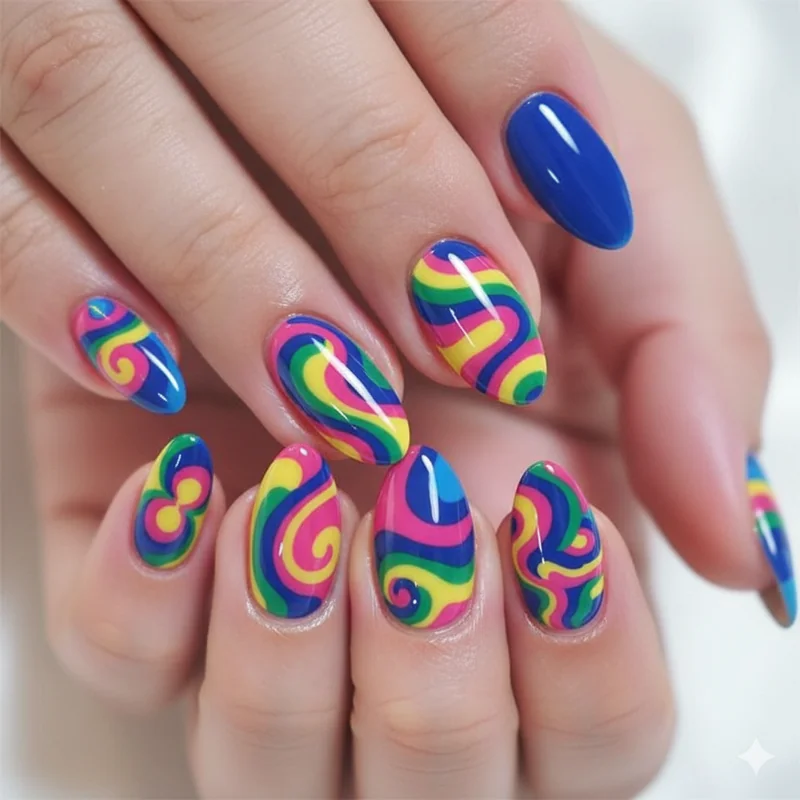
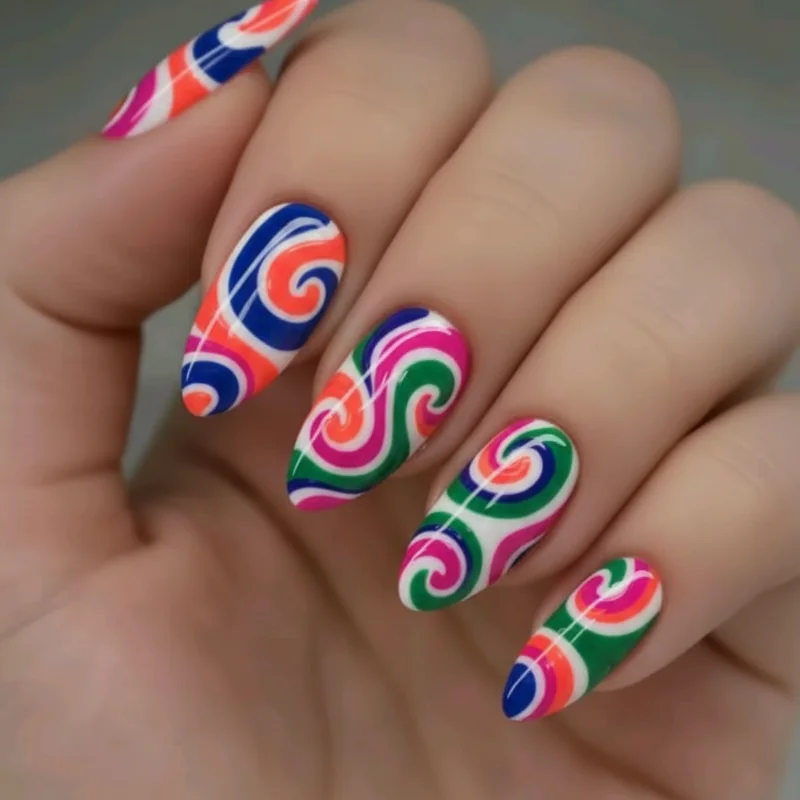
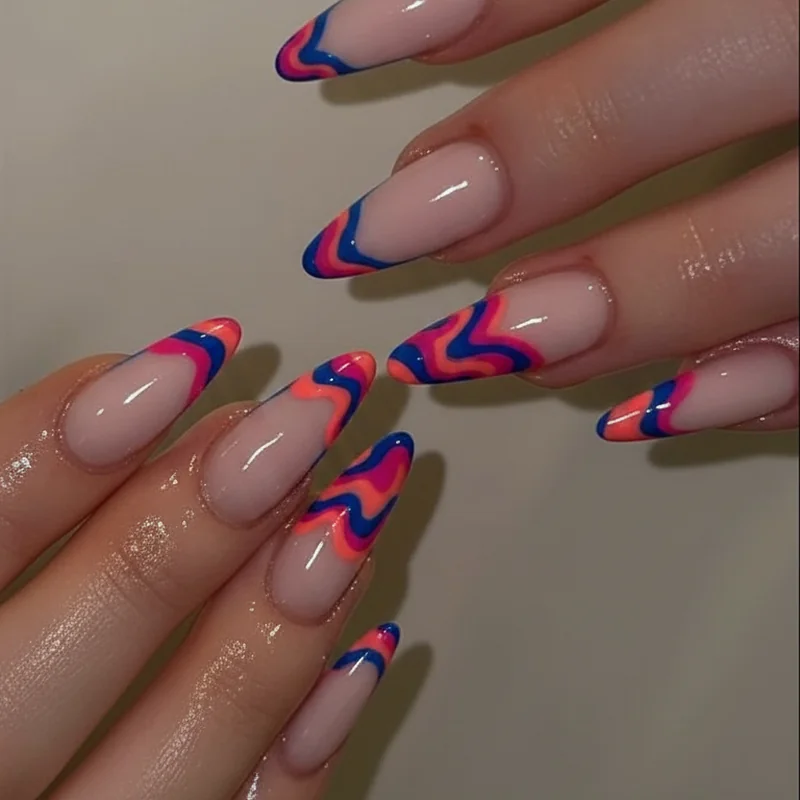
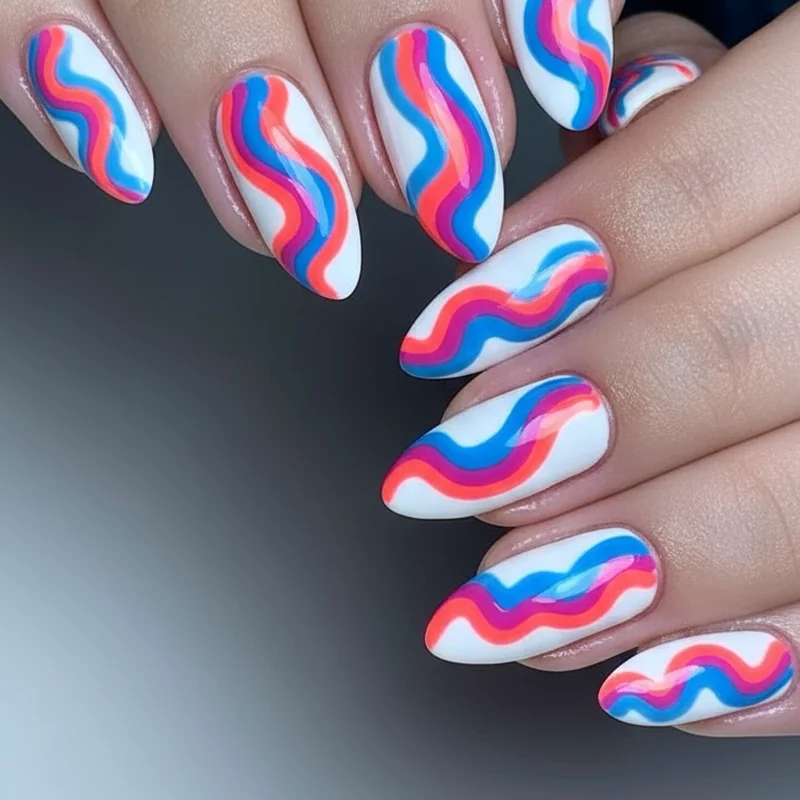
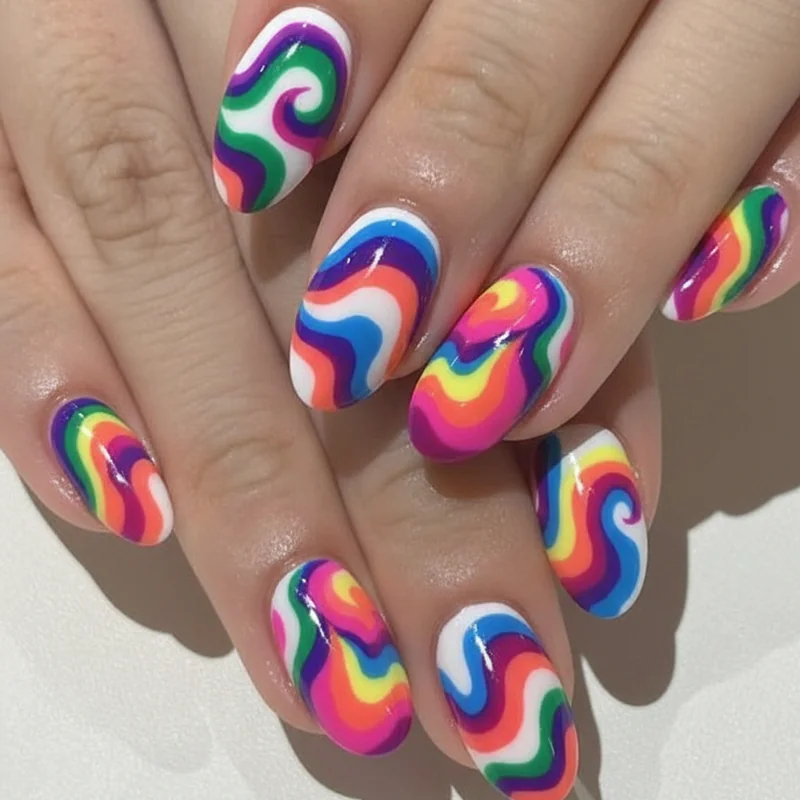
The nails you've been saving on Instagram for the past three months but haven't been able to name? Those are pucci nails and the reason you keep stopping on them is exactly the reason the Emilio Pucci fashion house built an empire on this print in the 1960s. Wavy ribbons of colour, abstract swirls that move like liquid, a palette that should clash but somehow doesn't. Pucci nails are having their biggest moment yet in 2026, and they have arrived at exactly the right time.
This is not a coincidence. Nail art and fashion are running parallel right now both reaching for maximalism, both leaning into retro print energy, both asking the same question: what does it look like when you commit? The Pucci print, with its psychedelic swirls and vibrant colour combinations, is the answer a lot of people are arriving at. As nail artist San Sung Kim told Who What Wear earlier this year, the minimalist phase has run its course. "We want a little bit of maximalism. It's good to have a little fun."
What follows is everything you need to know about pucci nail art before your next appointment which version suits your nail shape, which colour combinations actually work, whether you can pull this off at home, and how to wear a maximalist set without looking like you tried too hard.

Why Pucci Nails Are Everywhere Right Now
Fashion has been telling us this was coming. The Emilio Pucci nail art moment is not a social media accident it is the direct downstream effect of fashion's maximalism pivot landing in the nail space, which is exactly where trend energy tends to crystallise. When the runways shift, the nail artists follow. And right now, both are pointing in the same direction.
The Pucci print itself dates to the 1960s, when Emilio Pucci created his signature abstract swirls and vibrant colour palettes for a clientele of jet-setters and tastemakers who wanted clothes that felt as alive as they were. The silhouettes were simple. The prints did all the work. That tension a clean form carrying a riotous surface is precisely what makes the pucci manicure so compelling on a nail. The nail itself is the simple form. The print is the riot.
In 2026, that energy maps onto something larger. InStyle called it "refined maximalism." Byrdie documented the "chic chaos" moment in manicure trends. And as one nail artist noted when discussing patterned manicures: "When fashion leans one way, nail art follows." The print resurgence that started with stripes on the spring 2025 runways has moved through polka dots and plaid, and Pucci-inspired swirls are where that trajectory has landed for summer. You can see the full arc of this moment in our Summer Nail Trends 2026 guide the patterned manicure story is bigger than any single print.
The cultural nickname has followed. "Pucci Girl Summer" is appearing in beauty editorial as shorthand for the whole dopamine nail, resort-ready, unapologetically vibrant aesthetic. If your mood board has been skewing colourful, this is why.

What Pucci Nails Actually Look Like (And Why They're Not All the Same)
Search "pucci nails" and you will find at least five distinct versions passing under the same name. Knowing the difference matters before you walk into a salon, because "I want Pucci nails" without a reference image is about as specific as "I want something nice."
The most common version is the full-coverage abstract swirl: wavy, fluid ribbons of two to four colours covering the entire nail plate in overlapping curves. The colours don't fill separate sections so much as they weave through each other a technique that requires a striping brush and confident freehand movement. This is the version that stops a scroll.
A second, slightly quieter interpretation uses a Pucci-inspired colour palette on a white or nude base, with the swirl design contained to one or two nails as accent art. It reads as fashion-aware without committing to full pattern coverage on every finger.
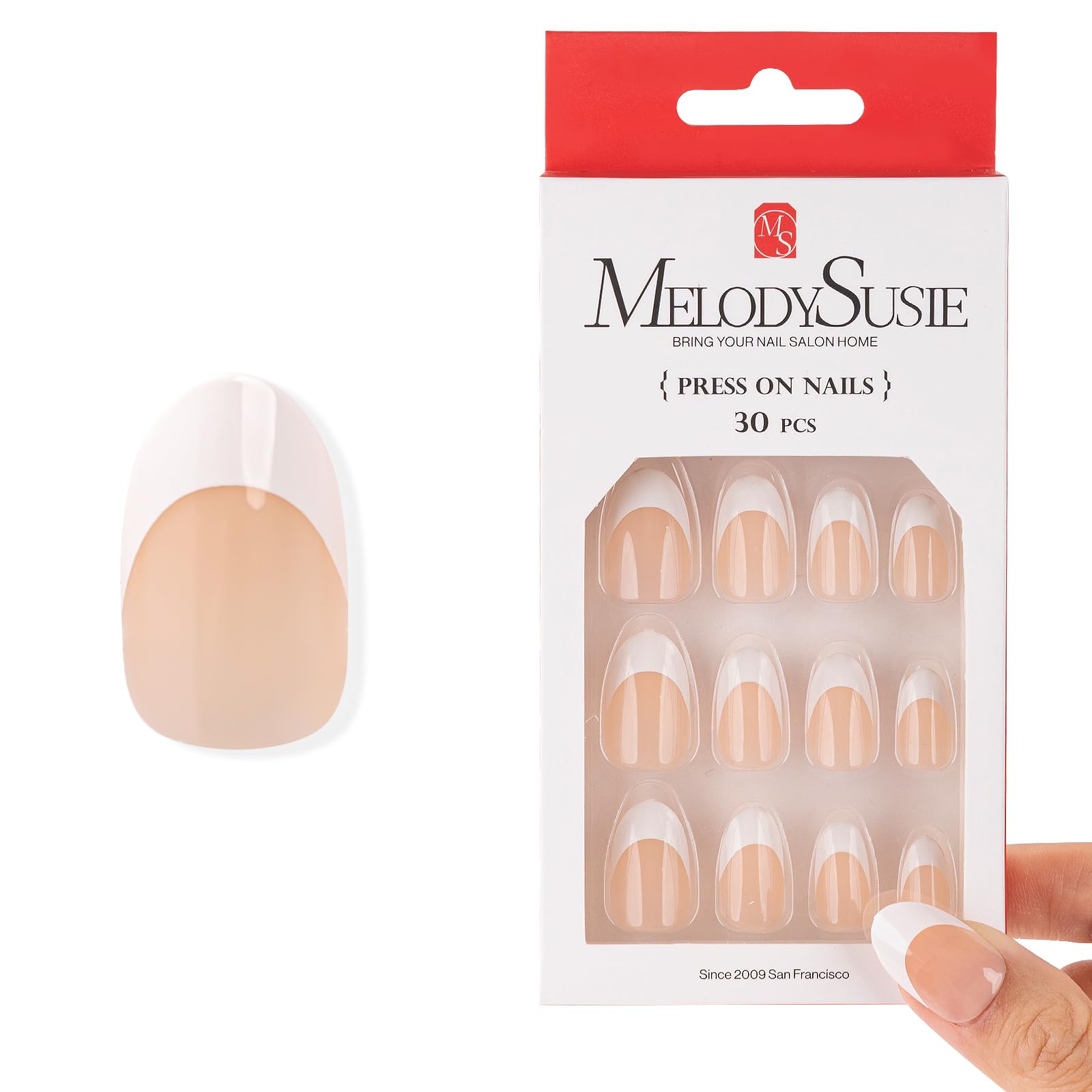
Then there is the Pucci French tip its own category, and one worth its own section (see below). And at the more accessible end, press-on nail art has expanded to include abstract print designs that approximate the Pucci aesthetic without requiring freehand skill at all.
The constant across every version: fluid lines, a deliberate colour palette, and the sense of movement. Stiff, angular marks are not Pucci nails. The fluidity is the whole point.