Does Icy Blue Chrome Suit Your Skin Tone? (The Honest Answer)
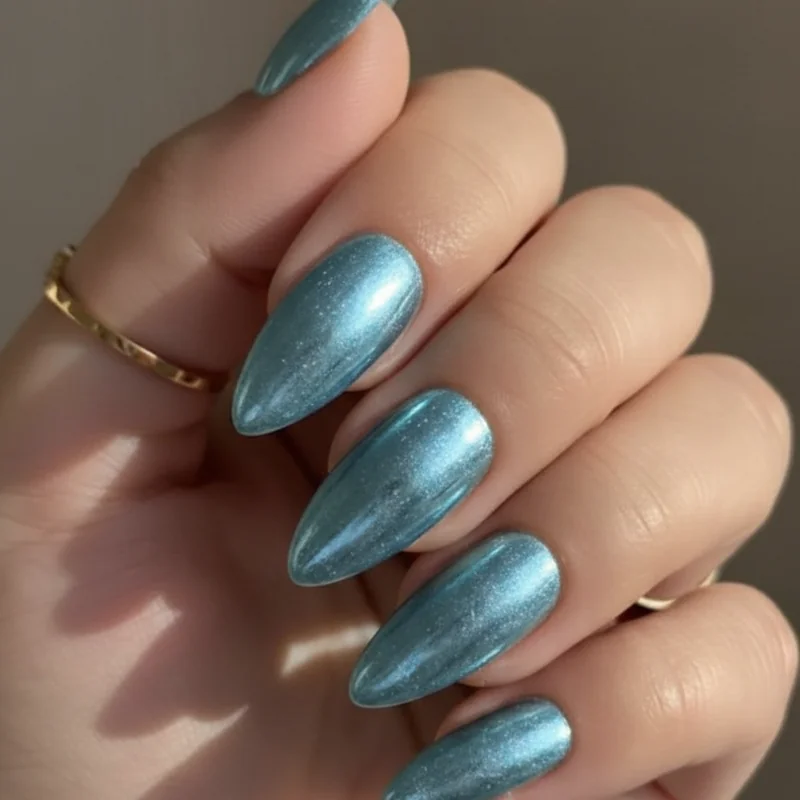
Cool undertones, the ones with pink, blue, or red-purple in the skin, suit icy blue chrome immediately and without adaptation. The colour echoes the undertone naturally.
Warm undertones are the question everyone searches for and nobody answers properly. The short answer: yes, with one adjustment. A white or silver gel base, rather than a blue gel base, neutralises the contrast and lets the chrome read as a cool metallic rather than a stark cool-vs-warm clash. The ice in the finish does the work: the metallic quality flatters warmth in the skin in a way a flat blue polish would not. Neutral undertones sit comfortably with either base choice.
For a deeper look at how icy chrome lands across different skin tones, Nail Color Trends 2026 for Every Skin Tone covers undertone matching in detail. Icy blue is also part of the wider Summer Nail Colors edit if you want to see how it sits alongside the rest of the 2026 palette.
What You Actually Need Before You Start (Tools + Products)
Three things are non-negotiable. Everything else is flexible.
No-wipe top coat. Not regular top coat. Not gel polish. A no-wipe formula specifically. It is the only product that produces the right surface for chrome powder to bond to. The chrome powder application guide from Bluesky Cosmetics is a useful product-specific reference here.
A silicone applicator or firm eyeshadow sponge. Brushes create streaks. The silicone or sponge tool is what produces the burnishing motion that aligns the powder particles flat. Most chrome powder kits include one; if yours did not, a dense eyeshadow sponge works.
Blue chrome powder. For the icy finish specifically, look for powders labelled ice blue, glacier blue, or baby blue chrome rather than cornflower or cobalt, which read warmer and more saturated. The icy quality comes from powders with a silver-blue rather than a purely blue pigment.
You will also need a UV/LED lamp, gel base coat, and a gel colour if you want a base other than clear. If you want a pre-curated kit rather than sourcing each piece individually, Best Summer Nail Polish Sets 2026 has options that include chrome.
Step-by-Step: How to Do Icy Blue Chrome Nails at Home
Step 1: Prep. Push back cuticles. File and shape your nails. Buff the surface lightly to remove shine, then wipe each nail with isopropyl alcohol on a lint-free pad. Any oil or dust left on the nail plate will prevent gel from adhering properly. This step is not optional; prep failures show up in chrome more than in any other finish.
Step 2: Base coat and colour. Apply gel base coat and cap the free edge. Cure fully. If you are using a coloured gel base (white, pale grey, or a blue gel), apply it now in one or two thin coats, curing between each.
Step 3: No-wipe top coat, half-cured. This is the step that determines everything. Apply a thin, even layer of no-wipe top coat and cure it for 30 seconds only, half the standard 60-second cure time. The top coat will be hard but still warm from the lamp's exothermic reaction. That warmth and residual grip is what the chrome powder bonds to. Cure for the full 60 seconds and the surface is too hard; the powder will not transfer properly. Apply chrome powder to a still-sticky layer and you get glitter, not glass.
Step 4: Apply chrome powder. Working one nail at a time, take a small amount of powder on your silicone applicator and rub in firm, circular motions across the nail. You will see the mirror effect appear as you buff. Keep going until the surface is uniformly reflective. Dust off excess with a clean brush before moving to the next nail.
Step 5: Seal. Apply a final layer of no-wipe top coat over the chrome, cap the free edge carefully, and cure for the full 60 seconds. Capping the tip here is what prevents the chrome from lifting at the edge within the first few days.
Why Your Chrome Looks Glittery Instead of Mirror-Like (And How to Fix It)
If your result looks sparkly rather than reflective, the surface was too sticky when you applied the powder. This happens when the no-wipe top coat is under-cured (less than 30 seconds) or when chrome powder is applied to regular gel polish's inhibition layer rather than a cured no-wipe top coat. Glitter means the particles could not align: they stuck at random angles instead of lying flat.
The reverse problem, powder that barely transfers or rubs off entirely, means the top coat was over-cured and too hard to grip the pigment.
The fix in both cases is the same: the half-cure method. 30 seconds under a standard 48W LED lamp, powder applied immediately while the surface is still warm. The professional chrome troubleshooting guide from Scratch Magazine confirms cure time as the primary variable in chrome application failure.
If chrome is lifting at the tip within days, the free edge was not sealed. Going back to cap the edge with top coat before the final cure solves this almost every time.