How to Read Your Hand Proportions in 30 Seconds
Most people assume knowing their hand type is complicated. It is not.
How do I figure out my hand type for nail shapes? Three quick visual checks, done in order, give you everything you need. Hold your dominant hand flat in front of you, palm facing you. First: look at the palm itself is it noticeably longer than it is wide, roughly square, or wider than it is long? Second: look at your fingers relative to the palm do they look long in proportion to the palm, short, or roughly equal? Third: note whether your overall hand reads as large, small, or average. You do not need a ruler. You are looking for relative impressions, not measurements.
Long, narrow palms with longer fingers have the most flexibility most shapes sit well on them. Short or wide palms with shorter fingers need shapes that create vertical movement: oval, almond, or round. Wide palms with longer fingers can carry most shapes but benefit from some taper rather than full blunt square edges. The combination matters more than any single variable, which is why the best nail shape for your hands is always assessed across all three factors before any verdict.
The free edge is the part of the nail that extends beyond the fingertip the length of the free edge and the shape it is filed into together create the overall nail silhouette. Your cuticle line also offers a quick assessment shortcut: the shape of your proximal nail fold tends to read more harmoniously when mirrored by your nail shape. A curved, rounded cuticle line typically looks more balanced with oval or round shapes; a flatter, straighter cuticle line tends to suit squoval or square.
If you want a dedicated step-by-step assessment, how to find your nail shape walks you through it in full.
How to Identify Your Nail Bed Width
Nail bed width is the horizontal measurement of the visible nail plate from one sidewall to the other at the base and it determines how wide or narrow the nail appears relative to the finger.
Which nail shape suits wide nail beds? Almond or oval. The taper draws the eye inward toward the centre of the nail and then up toward the tip, which creates a narrowing visual effect. Shapes with straight lateral edges square, squoval allow the full width of the nail bed to read without interruption, which emphasises width rather than reducing it.
Look at one of your nails straight on. Does the nail bed fill most of the width of the finger, or does it sit narrower with visible skin on either side? Wide nail beds tend to extend close to the fingertip edges. Narrow beds sit clearly within the fingertip. Average beds roughly match the width of the upper portion of the fingertip.
If your nail bed is wide, tapered shapes are doing mechanical work not just stylistic work for your hands. The shape is actively redirecting the eye. If your nail bed is narrow, you have more flexibility: straight-edged shapes look structured without adding the width effect they would create on a wider bed. Nail bed width is one of the most overlooked inputs when women are searching for the best nail shape for your hands recommendations that actually hold up.
Wide nail beds have their own full set of considerations the guide on nails for wide nail beds covers every shape that works, with the reasoning behind each one.
Nail Strength: The Factor Most Guides Ignore
Nail strength decides more shapes than most people realise. Knowing the ideal shape for your hands and knowing whether your natural nails can hold it are two completely separate pieces of information and most guides give you the first without any acknowledgement of the second.
What nail shape should I get if I type all day? Squoval or oval. Rounded corners do not catch on keys or fabrics the way square corners do, and the length stays practical for daily function without the upkeep that longer almond or coffin requires.
What is the most durable nail shape on natural nails? Round, then squoval. The C-curve is the natural arch of the nail plate when viewed end-on shapes like round and oval preserve this curve, which distributes mechanical stress and makes nails more resistant to breakage. Square corners concentrate impact at a single point. Round edges spread the same force across a continuous curve. The more surface area absorbs the impact, the less likely any one point is to crack.
If your nails break consistently before reaching medium length, that constraint shapes what is practically possible before any aesthetic conversation begins. Almond on natural nails that can only hold short length does not look like almond it looks like a failed oval. Identifying the best nail shape for your hands at this stage means factoring in what your nails can actually hold, not just what you want them to look like. The options are to reinforce with gel overlay, which adds structural support without adding visible length, or to choose a shape that reads correctly at shorter lengths, such as oval or squoval. Extensions and press-ons are a legitimate bridge option if you want almond or coffin but cannot grow natural nails to support them.
The Shape That Flatters Each Hand Type Combination
So which one is actually yours?
Here is where the three factors map to a real verdict. Read the combination that matches your hands proportions first, nail bed width second, strength note where relevant.
Short fingers, average or wide nail bed: Oval or almond. Both taper toward the tip, creating a vertical line the eye follows upward. Almond creates more elongation but needs more free edge oval works at slightly shorter lengths. Avoid square and squoval if your nail bed is wide; the straight lateral edge adds horizontal emphasis you do not want. If your nail beds are average width, squoval is a workable option if you prefer structure. The dedicated guide on nails for short fingers goes deeper into design options across all lengths.
Short fingers, narrow nail bed: Round or oval. Narrow nail beds have more shape flexibility, but the priority is still vertical movement on shorter fingers. Round is the most durable option here and does not look unsophisticated at shorter lengths.
Long fingers, narrow nail bed: Square or squoval. Long fingers do not need additional elongation a very tapered shape on very long, narrow fingers can read as severe. Square gives structure; squoval softens it slightly. Long fingers open up shapes that would overwhelm shorter hands the guide on nails for long fingers covers all of them, including coffin and stiletto options.
Long fingers, wide nail bed: Almond or oval. Even with length on your side, a wide nail bed benefits from the narrowing effect of a tapered shape. Square on a wide nail bed with long fingers reads as a wide, blunt finish.
Small hands overall (short palm, shorter fingers): Oval. Scale matters on smaller hands almond and coffin at medium to long lengths can overwhelm small hands and make the nail look disproportionate to the finger. Oval at short to medium length is the most reliably flattering choice. If overall hand proportion is your concern rather than finger length alone, nails for small hands addresses that specifically.
Wide palm, chubby fingers: Almond or oval, with some length. Width across the finger is best countered by a shape that draws the eye upward taper creates that movement. Keep length at medium or above to let the shape do its work. If width is your primary concern, nails for chubby fingers has the full flattery breakdown.
What Each Nail Shape Actually Does to Your Hands
Think of nail shapes not as aesthetic labels but as tools. Each one performs a specific visual function on the hand. Understanding what the tool does tells you when to use it.
What is the most flattering nail shape for everyone? Squoval suits the widest range of hand types. Squoval is a nail shape that combines the straight sides of a square nail with gently rounded corners it eliminates the sharp corner that causes snagging while keeping the structured, modern look of a square. It is not the most dramatic choice, but it is the shape least likely to work against you.
Round follows the natural curve of the fingertip and creates a soft, finished look. It reads clean on short nails and does not extend visually beyond the fingertip. On wider nail beds, round is more forgiving than square but not as actively narrowing as oval. Its primary advantage is durability no corners to catch on anything.
Oval tapers slightly on the sides and rounds at the tip, following a longer arc than round. It elongates the finger by drawing the eye toward the tip. On wider nail beds, the taper creates a narrowing effect. It works across most hand type combinations because it neither adds horizontal emphasis nor requires extreme length to read correctly.
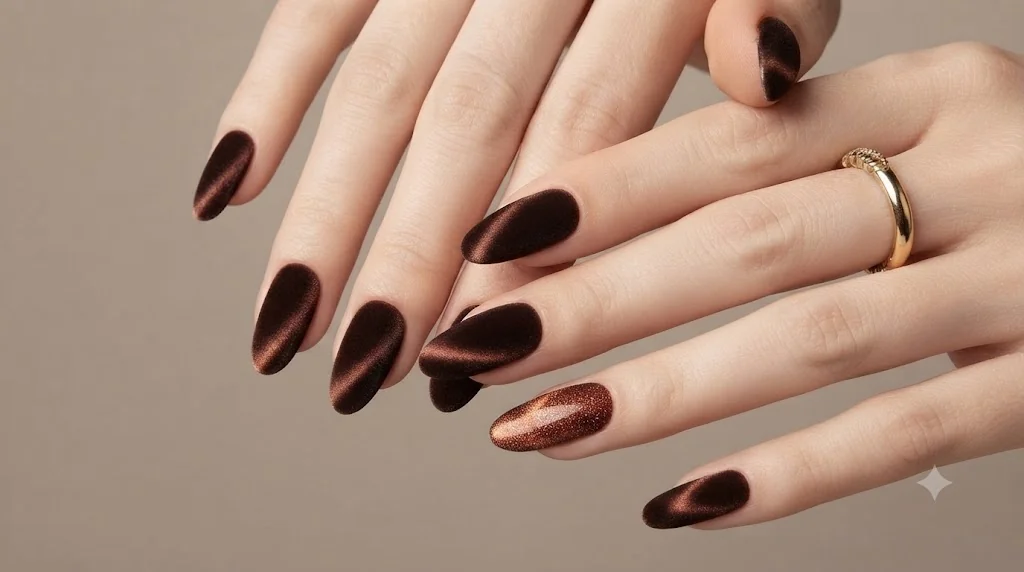
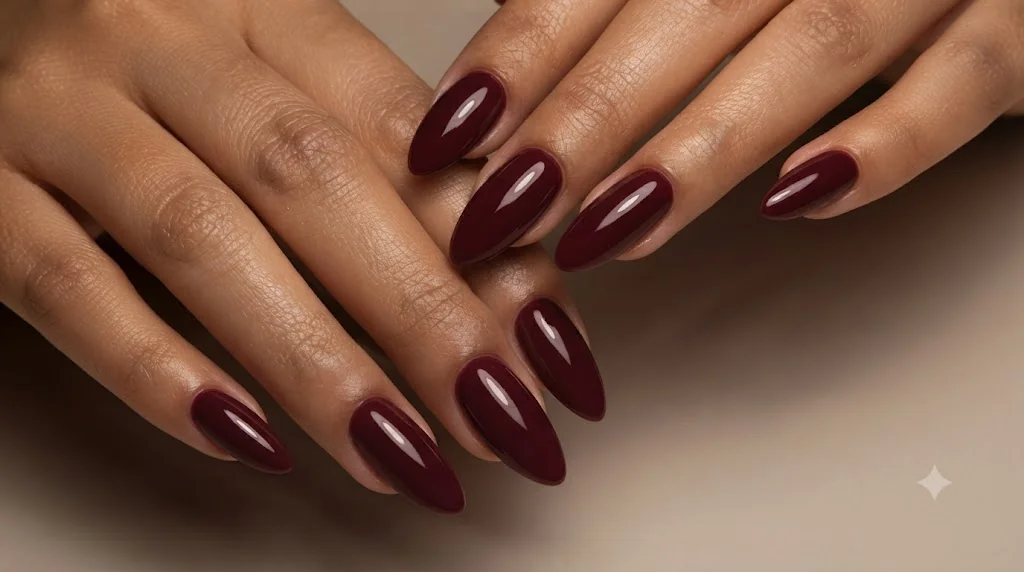
Almond tapers more aggressively on the sides and ends in a soft, rounded peak. The narrowing effect is stronger than oval on wider nail beds, the taper actively redirects the eye inward and then upward, which visually slims both the nail bed and the finger. It requires more free edge than oval and benefits from some structural support on natural nails. For a full breakdown of why almond works on most hands and how to get it at every nail length, see the complete almond nail guide covering every hand type, length, and application option.
Square has straight lateral edges and a flat, horizontal tip. On narrow nail beds with long fingers, this reads as modern and structured. On wide nail beds or short fingers, the straight edges emphasise horizontal width rather than counterbalancing it. The corners are also the first point to chip or catch on fabrics. Coffin tapers on the sides and ends in a flat, squared-off tip longer than square, narrower at the sides. On longer fingers, the tapered body provides elongation before the flat tip lands. On short fingers, the flat tip cuts the vertical movement before it reaches a visual conclusion and requires length to read as intended.
OPI's nail shape guide by hand type offers a shape-by-shape industry reference if you want a second read on each shape's mechanics.