Independent nail tech vs salon is not a question with a universally correct answer, and anyone telling you otherwise is selling a side. It comes down to three numbers: how much savings you're sitting on, what your state actually allows, and how long you can survive a slow first few months while clients find you. If you licensed recently or you're a year or two into salon work, you're probably staring at these two paths right now wondering which one is the smart move rather than just the exciting one. Most independent nail tech vs salon comparisons out there have already picked a side, either painting independence as the obvious upgrade or salon work as the safe consolation prize. Neither framing is honest, because the right answer depends entirely on your specific finances, risk tolerance, and location, not on which path sounds more entrepreneurial. This piece resolves it with real dollar figures, the legal reality most guides skip, and a self-assessment you can apply to your own situation before you make a move. If you haven't finished the licensing steps yet, how to become a nail tech covers that ground first.
What Does "Independent Nail Tech" Actually Mean?
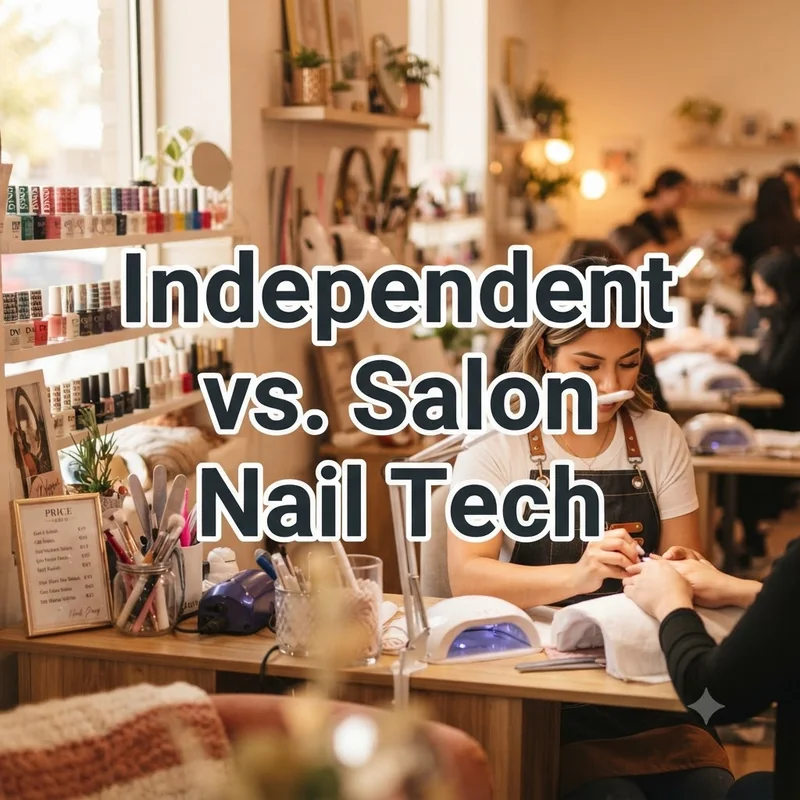
"Independent" gets used as a catch-all term, and that vagueness is exactly what makes the comparison feel impossible to resolve. There are three distinct versions of it, and confusing them is why so many pros/cons lists fall apart before they say anything useful. Booth rental means paying a salon a fixed weekly or monthly fee for a station, while operating as an independent contractor who keeps every dollar of service revenue you bring in. Mobile work means no fixed location at all. You travel to clients with a portable kit, which eliminates rent but adds transport time and a smaller daily client ceiling. A home studio sits somewhere in between: no salon rent, but a real investment in space, equipment, and often a permit depending on your local zoning rules.
Each version carries a different cost structure and a different daily rhythm, and lumping them together as one "independent" bucket is how competitor content ends up giving advice that doesn't actually apply to your situation. Booth renters get salon foot traffic and a professional space without a boss. Mobile techs get total schedule control at the cost of built-in demand. Home studio owners get the most autonomy and the highest upfront investment. Knowing which version you're actually weighing against salon employment is the first real decision, before any income or lifestyle comparison means anything.
Independent Nail Tech vs Salon Employee: Income Compared
Salon employees typically start in the high twenties to low thirties in annual pay, often on an hourly base plus tips, while a booth renter keeps 100 percent of service revenue minus rent and supply costs. Neither number tells the full story on its own. A salon paycheck is predictable and arrives whether the week was fully booked or slow, but it has a visible ceiling tied to the salon's commission structure. Independent income has no ceiling, but it also has no floor, which matters enormously in month one when your client list is still short.
Independent nail tech vs salon income comparisons usually stop at "keep 100% of what you make," which sounds like an obvious win until the actual math runs. A booth renter paying the national average of $252 a week needs roughly $1,008 a month in service revenue just to break even on rent alone, before supplies, insurance, or a single dollar of profit. A salon employee has no equivalent hurdle. Their commission split reduces every service, but it reduces from zero risk rather than adding a fixed cost that exists regardless of how many clients walk in. For a full breakdown of what salon roles actually pay by experience and location, what nail technicians really earn lays out the complete range. The honest read: independence has a higher ceiling and a real floor problem, salon work has a lower ceiling and almost no floor risk.