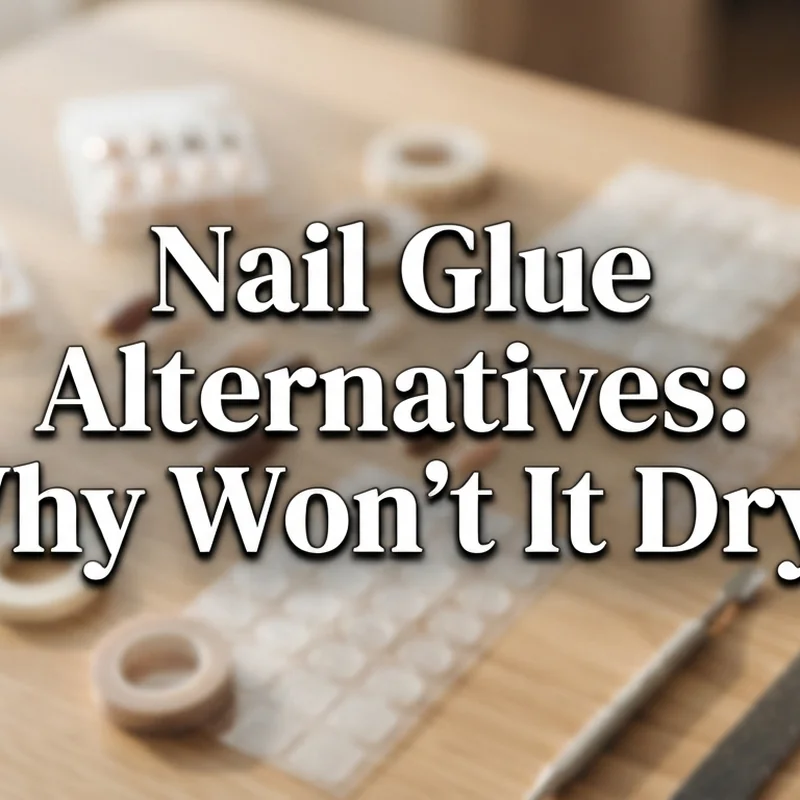
Nail glue fails to dry for one of three reasons: leftover oil or moisture on the nail plate, glue that has passed its shelf life, or too thin a layer applied without enough pressure to bond. Nail glue alternatives solve this a different way entirely, by skipping cyanoacrylate altogether. If you have ever stood there watching a tip lift back off a still-tacky nail, or fought a tube that will not budge, you already know the standard advice ("just buy new glue") only ever solves half the problem. This post solves both halves. It walks through exactly why glue stalls out on the nail, exactly why the bottle itself seizes up, and then hands over real nail glue alternatives for anyone who would rather sidestep the whole mess.
Two separate readers land here, and most guides only ever talk to one of them. Maybe your glue just failed mid-manicure and you need it fixed in the next five minutes. Or maybe you are done with cyanoacrylate altogether, whether that is a sensitivity issue, a reusability wish, or simple exhaustion with the smell and the mess. Both problems get answered here, in order: what went wrong, how to fix the bottle itself, whether super glue is a legitimate stand-in, and which alternative actually fits your situation.
Why Won't My Nail Glue Dry?
Nail glue stays tacky when the nail surface still has natural oils on it, when the glue has gone past its effective shelf life, or when the layer applied was too thin to fully polymerise under normal pressure. Cyanoacrylate, the compound in nearly every nail glue formula, cures through a reaction with moisture in the air rather than by air-drying the way regular polish does. That single fact explains almost every failure mode.
Oil is the biggest offender. A nail plate that has not been washed, buffed, or wiped with alcohol still carries a thin film of sebum, and cyanoacrylate cannot bond through it. The glue sits on top of the oil instead of reacting into the nail surface, which is exactly why it stays wet and shiny instead of setting hard. Buffing lightly to break the shine, then wiping with rubbing alcohol or a nail dehydrator, removes that barrier before a single drop goes on.
Old glue is the second culprit. Cyanoacrylate has a shelf life of roughly six to twelve months once opened, and it begins reacting with ambient moisture from the very first use. A bottle that has sat open, warm, or humid for months will apply thinner, slower, and tackier than a fresh one, even if the bottle still looks full. If a bottle is more than a year old, or the glue runs unusually thin and slow, that is your answer.
Application technique closes out the list. A too-thin layer does not give the cyanoacrylate enough material to fully cure, and skipping the firm ten-second hold after placement means the bond never sets under pressure. Nail techs count that hold out loud for a reason. It is not superstition, it is the exact window the chemical reaction needs.