Round vs Square Nails: Side-by-Side Comparison
Put the two shapes next to each other and the trade-offs stop being abstract. The round vs square nails decision comes down to a handful of concrete factors, and almost nothing splits evenly down the middle.
| Factor |
Round |
Square |
| Chip resistance |
Higher, no stress point |
Lower, corners crack first |
| Typing comfort (all day) |
Higher, no snag points |
Lower over long sessions |
| Typing precision (short bursts) |
Standard |
Slightly higher, flat surface |
| Visual finger length |
Shorter appearance |
Longer, elongating line |
| Best nail bed match |
Narrow to average |
Average to wide |
| At-home upkeep |
Forgiving |
Shows unevenness fast |
| Filing time in-salon |
Slightly longer |
Faster |
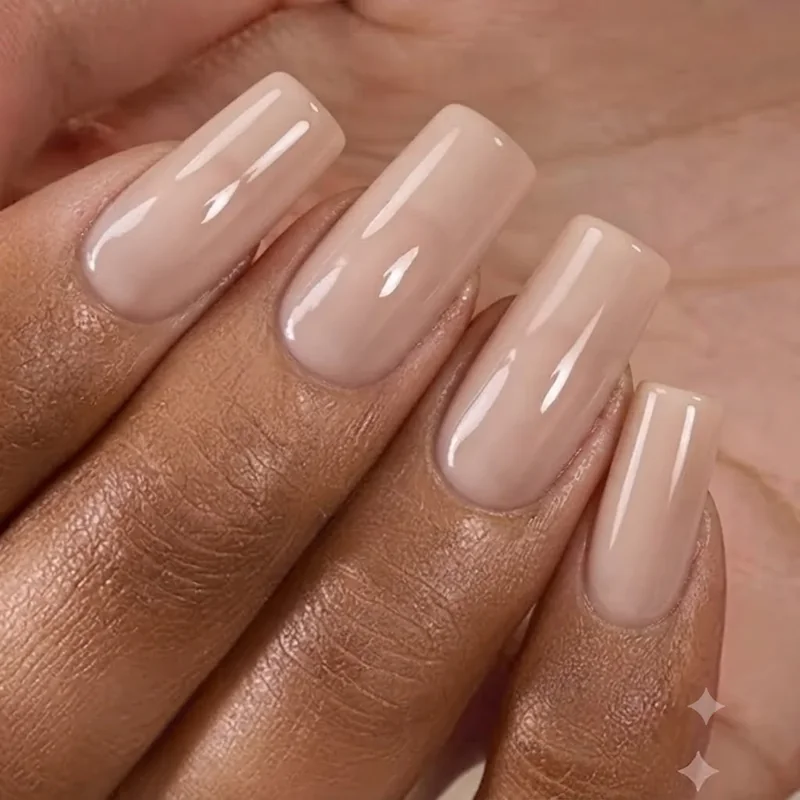
Square nails hold their appeal for a reason beyond salon convenience. The straight sidewalls give a geometric, structured look that reads as deliberate, and on a wider nail bed that structure can look genuinely sharp rather than harsh. If you want the deeper dive into where square earns its place, the full square nails shape guide covers styling and upkeep specifics this comparison doesn't have room for.
What the table doesn't show is how these factors interact with your actual week, and that's where the next few sections go: durability under real wear, typing and daily tasks, how each shape reads professionally, and which one fits your hand type.
Which Nail Shape Breaks or Chips Less?
Round nails break and chip less than square nails. Durability is one of the clearest gaps in the entire round vs square nails comparison: the 90-degree corner on a square nail is a concentrated stress point, so impacts that a round nail would simply absorb tend to crack a square nail right at that corner.
This isn't marginal. Every knock against a doorframe, every dig into a tight jean pocket, every catch against a laptop edge sends force somewhere on the nail, and where that force lands decides whether you get a clean flex or a visible crack. Round spreads that force along the curve. Square concentrates it at the corner, exactly where the nail is structurally thinnest. Independent shape comparison data on stress distribution confirms the same pattern holds regardless of polish type.
A lot of this comes down to the nail's C-curve. C-curve is the natural arch of the nail plate as it curves from sidewall to sidewall, and a nail with a pronounced C-curve has more structural support at the edge to begin with. A flatter nail plate has less of that built-in reinforcement, which means square corners on a flat nail plate are especially prone to chipping, while the same square shape on a nail with a strong C-curve holds up noticeably better. If you already know your nail plate runs flat, that's a real reason to lean round regardless of which shape you find more attractive.
Gel and dip powder narrow this gap somewhat, since both add a layer of reinforcement the corner didn't have on bare polish. They don't eliminate it. A squared gel manicure still chips at the corner before it chips anywhere else, just less often than a squared regular-polish manicure would. For a full breakdown of how every shape ranks on this exact metric, which nail shape is the strongest covers the complete durability order beyond just round and square.
Round or Square: Which Is Better for Typing and Daily Tasks?
Round wins for typing all day, and square only edges ahead in short, precision-heavy sessions. This is the most contested part of the entire round vs square nails debate: the contradiction you've seen across other sites, some claiming square is better for typing and others claiming round, comes down to session length, and nobody names that distinction directly.
Square's flat leading edge does give a marginally more stable contact point for a small number of keystrokes, which is the scenario square advocates are describing. That advantage disappears the moment typing becomes sustained. Over a full workday, square's corners start catching on keyboard edges, phone cases, and the gaps between keys in a way round nails simply don't, because round has no corner to catch on. Anyone who types for eight hours straight in square nails hits the corner-snag complaint fast.
This same logic extends to daily tasks generally. Square nails snag on clothes more than round nails do, and it's the most common complaint from people who've worn both shapes back to back. Pulling on a sweater, reaching into a bag, running fingers through hair, all of these involve fabric or hair passing across the nail's edge, and a corner is a snag point in a way a curve never is. Manual tasks follow the same pattern: gripping tools, buttoning garments, and typing on a physical keyboard all favour a shape with no sharp edge to interrupt the motion.
If your day is genuinely dominated by short bursts of precision typing, like transcription or data entry in tight sprints, square's flat edge is a legitimate small advantage. For nearly everyone else weighing round vs square nails against a real workday, round is the better daily-wear shape, full stop, no hedging required.
Which Shape Looks More Professional?
Neither shape is inherently more professional than the other. On the round vs square nails question specifically, round reads as polished and understated, square reads as structured and deliberate, and both land as appropriate in a corporate setting when the shape is well maintained.
What actually damages a professional look isn't the shape itself, it's upkeep. A round nail that's grown out slightly still looks intentional, because the curve absorbs minor asymmetry without drawing attention to it. A square nail that's grown out slightly shows it fast: one corner sits higher than the other, or the straight edge starts to angle, and that unevenness is what reads as neglected in a meeting room, not the shape choice underneath it. If your schedule means longer gaps between manicures, round will hold a professional appearance for longer without a touch-up.
Industry perception adds a layer here too. Square has a slightly more "done" or salon-fresh association because it requires more precise filing to execute well, while round has a natural, low-maintenance association that reads as effortless rather than lazy in most workplace contexts. Neither reading is wrong. Choose based on how your hands are actually used day to day at work, and how often you can realistically get back in the chair, rather than chasing whichever shape looks sharper in a single photo.