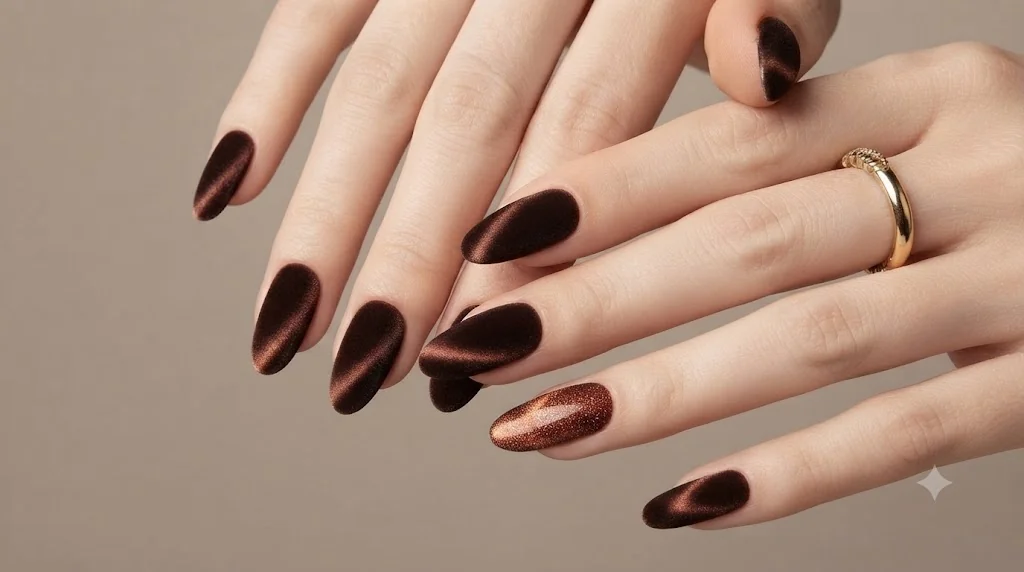
She has seen the Tokyo salon photos. The nails that look bare until you look closer, and then you notice the one fine black line, or the single painted bud no bigger than a grain of rice. She already owns the minimalist instinct. What she wants now is the version that has a reason behind it, not just a smaller colour palette.
Japanese minimalist nails are not a stripped-down version of the clean-girl manicure she already knows. They come from a different place entirely. What separates japanese minimalist nails from generic neutral nail art is philosophy: a set of Japanese aesthetic ideas that decide what gets left bare and why. That distinction is the whole point of this post, and it is the thing competitors writing broad Japanese nail roundups never quite get to.
What Makes Japanese Minimalist Nails Look Different from the Rest
A bare nail is not an unfinished nail. That is the entire argument of this section, and it is the argument most Western minimalist content misses completely.
Japanese minimalist nails are nail designs that draw from Japan's cultural philosophy of restraint, negative space, and intentional simplicity. Unlike generic minimalist nails, they are shaped by specific aesthetic principles, wabi-sabi, ma, and shibumi, that give them a distinctly considered quality. The result is a manicure that looks quiet but never empty.
Wabi-sabi is the Japanese aesthetic philosophy that finds beauty in imperfection, impermanence, and incompleteness, the philosophical root that gives Japanese minimalist nails their quality of looking considered rather than sparse. A single brushstroke that wanders slightly off-centre is not a mistake to correct. It is the point. Western minimalism tends to chase a flawless, uniform finish; the Japanese version makes room for the human hand that made it.
This is not the only language for the same idea. Ma, the negative space principle, and shibumi, an understated elegance that asks for nothing and earns attention anyway, both feed into the same outcome: a nail that says more by doing less. The full world of japanese nail art runs from maximalist 3D to the quiet restraint this post covers, and the gap between those two ends of the spectrum is exactly the gap between decoration and intention.
She already has the instinct for restraint. This is the vocabulary for what she has been responding to without quite being able to name it, and it is grounded in the philosophy behind Japanese minimalism rather than a passing colour trend.
The Colour Palette That Defines Japanese Minimalist Nail Art
Matcha green on a bare canvas looks like nothing else in a Western minimalist gallery.
The Japanese minimalist nails palette centres on muted, nature-derived tones: matcha green, indigo, ash grey, nude beige, and pale gold. These differ from the Western clean-girl palette, less pink, less sheer, more tonal depth and cultural reference. Black on nude and white on ash are the two most distinctive colour pairings in this style.
There is a reason this palette photographs so differently. Western clean-girl nails lean on sheer pink and milky white because the goal is to disappear into the natural nail. Japanese minimalist colour does the opposite. It chooses tones with weight, indigo, ash, matcha, and lets that weight sit quietly rather than loudly. A pale gold accent against an ash base reads as expensive precisely because it is restrained rather than because it sparkles.
Tonal beige deserves its own mention. Not the pink-beige of a French manicure base coat, but a flatter, more grounded beige that sits closer to stone than to skin. Paired with a matte top coat, it becomes one of the most quietly confident looks in this entire post.
These tones also sit inside the wider 2026 minimalist nail trend directions, which have been moving toward earthier, less sheer minimalism all year. The difference is that Japanese minimalist nails arrived at this palette through philosophy, not trend forecasting, which is exactly why the look holds up.