Somewhere between a TikTok video and a salon appointment you have not booked yet, you saw them. Nails that looked less like a manicure and more like a tiny gallery piece. Soft gel flowers with actual petals. A gradient that shifted from nude to rose so gradually you had to look twice. A set so precisely balanced across all ten nails that it felt architectural. You saved the image. You searched vaguely for "Japanese nails" and came back with a page of results that told you approximately nothing about what you were actually looking at.
Japanese nail art is not a single aesthetic. It is an entire ecosystem of techniques, style families, and cultural values about what a manicure can be, and every image you have ever saved almost certainly belongs to a different corner of it. This post is the map. By the time you reach the end, you will know the name of what you want, why it looks the way it does, and exactly what to say when you sit down at your next appointment. There is also a japanese nail art inspiration gallery alongside this guide if you want to browse while you read.
What Makes Japanese Nail Art Different From Everything Else?
Japanese nail art is a design tradition and product system originating in Japan, defined by soft gel application, hand-painted precision, and a seasonal approach to design that treats the nail as a small canvas rather than a surface to be coated. The Japan Nailist Association (JNA) is the professional body overseeing certification standards for nail artists in Japan, widely considered the global benchmark for technical training and that institutional rigour shows in the results.
The most visible difference from Western nail work is the product. Most Japanese nail artists work with potted gel (also called soft gel), applied with a brush the technician selects for each step. This is the opposite of the polish-in-a-bottle approach common in Western salons, and it gives the artist a level of control that shows in the finish: colour is more pigmented with fewer layers, lines are crisper, and gradients are genuinely seamless. Japanese gel brands such as Kokoist and Vetro are formulated for flexibility, which is one of the reasons a Japanese gel set lasts closer to four weeks than the two you might expect from a standard salon.
There is also the question of intent. In Japan, nail design changes with the seasons. Clients return every four to five weeks for a full design refresh, and the seasonal calendar shapes everything from colour palette to motif. Cherry blossoms in spring, rain-texture gradients in early summer, ochre and mushroom in autumn. That rhythm produces constant innovation, which is why Japanese nail art looks different every time you search for it.
The JNA's training standards also mean Japanese nail artists spend years mastering specific techniques before working on clients. The the history and cultural significance of Japanese nail art shows how deeply craft is embedded in this practice. The difference between a Japanese-trained artist and a general gel technician is not about brand or price it is about what each person was taught to do with their hands.
Japanese versus Korean nail art. Both traditions use high-quality gel systems and both produce detailed, considered work. The distinction lies in aesthetic emphasis: Japanese nail art leans toward seasonal themes, dimensional 3D elements, and gradient-based depth, while Korean nail art tends toward glass skin finishes, aura and aurora effects, and micro-detail line work on a cleaner, flatter base. If your saved images have a watercolour or sculptural quality, you are likely looking at Japanese work. If they are more graphic, glossy, and minimal, the influence is probably Korean.

The Five Major Styles of Japanese Nail Art and Who Each One Is For
Every image in your saved folder belongs to one of five style families. This is a deliberate claim: japanese nail art is not an undifferentiated look. It is a set of distinct disciplines, and the people who love one do not always love the others.
The five are: kawaii (character-driven, playful, maximalist), minimalist and nuance (layered depth, restraint, quiet luxury), 3D sculptural (raised gel flowers, dimensional embellishments, wearable sculpture), blooming gel (fluid watercolour effects, organic movement, no two sets identical), and seasonal floral (the category that encompasses sakura nails and every other motif drawn from the Japanese calendar). These are not fixed categories sets frequently blend two styles, particularly nuance with floral or kawaii with 3D. But naming the style you are drawn to is the first step toward articulating it.
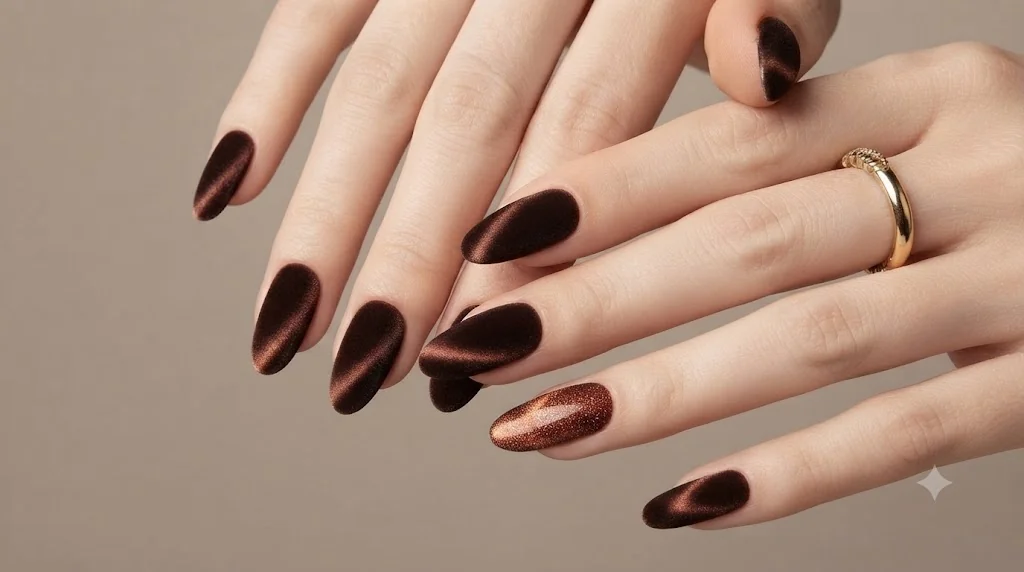
Across all five, certain technical constants hold. The nail shape is almost always softened oval, almond, or rounded square because Japanese nail art is designed to complement the hand, not compete with it. The base tends to be sheer or milky rather than fully opaque, allowing depth to build through layers. And the work is almost always done across all ten nails in a considered composition, not just two accent nails and eight plain ones.