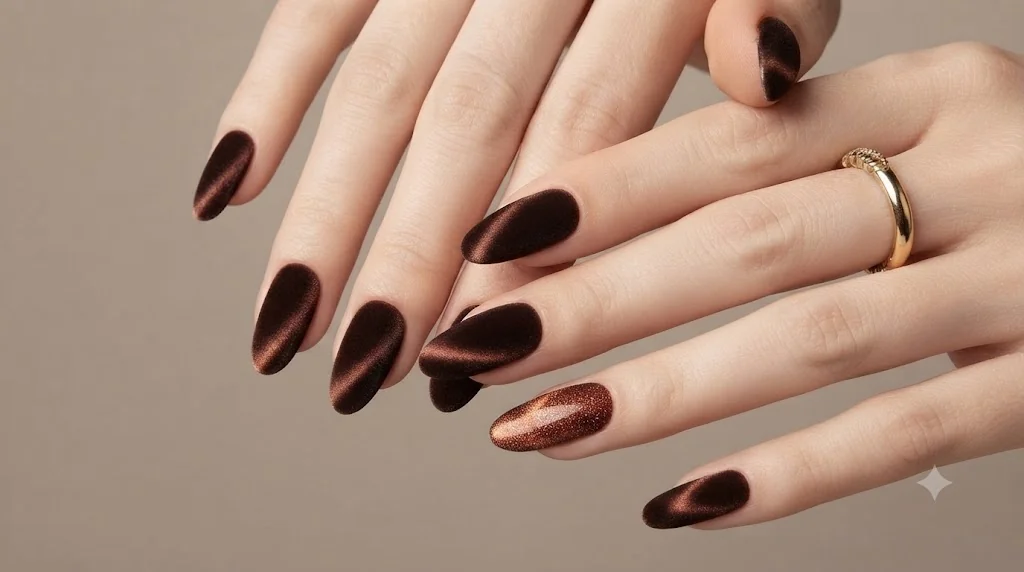
Every Japanese nail art post she saves shows long, sculpted almond nails. Every time. So she closes the tab, assumes it isn't for her, and books a plain gel instead.
Japanese nail art short nails is not a compromise version of the real thing. It is where several of these techniques were always meant to live. Tokyo salons have known this for years as NAILS Magazine has reported, clients at leading Tokyo salons routinely request no more than a 2mm free edge, and their nail techs design around it without a second thought. Certain Japanese nail art techniques, nuance gel gradation, blooming gel watercolour florals, micro sakura, negative space wabi-sabi designs, are not just possible at short lengths. They are better. The compact canvas forces precision. The absence of extra length makes every design element count.
This post names the specific styles that work at short nail lengths, explains the design logic behind each one, and gives you everything you need to walk into a salon and ask for exactly what you want.

Which Japanese Nail Art Styles Actually Work on Short Nails?
Japanese nail art short nails is not a niche workaround it is the standard at most Japanese salons. Several techniques within the broader world of japanese nail art are not just compatible with short nails; they are architecturally suited to them.
The reason most content gets this wrong is that it starts from the assumption that short nails are a constraint to design around. Japanese nail aesthetics start from a different premise entirely: the nail is a small, precise canvas, and the design should honour that scale, not fight it.
The styles that work best at short lengths share a common quality. They rely on technique and finish rather than surface area. Nuance gel gradation reads as complete on a short nail because the effect is about depth of colour, not distance across the nail. Micro sakura designs are calibrated to single petals, not full branches; a short nail gives them exactly the space they need. Negative space designs use the nail plate itself as part of the composition, which means a smaller plate is not a limitation it is the material. Blooming gel watercolour effects expand organically to fill whatever canvas they are given. Japanese nail stickers are printed at the scale of a nail tip, not an extension.
The styles that genuinely benefit from length elaborate 3D sculptural nail art, full-nail seigaiha pattern repeats, long coffin chrome geometrics are a separate conversation. They are not in this post because they are not the answer to what this reader is looking for.
What the reader is looking for is named here. Every design below is a real Japanese nail art technique, not a simplified version invented for short nails. The Tokyo salons doing these on 2mm free edges would not recognise the premise that short nails limit what is possible.

Nuance Nails: The Japanese Technique Built for Short Canvases
Nuance nails are a Japanese gel nail technique that uses layered gradation to create a soft, tonal colour transition across the nail closer to a watercolour wash than a standard ombre. The technique originated in Japan and spread globally because the finish is unlike anything achievable with regular polish or Western gel systems.
They suit short nails because the effect reads as refined and complete even on a compact canvas. There is no visual destination that gets cut off. The gradation exists in the depth of the colour layers, not across the length of the nail. A nuance finish on a squoval short nail looks considered and whole. On a longer nail, the same technique risks looking like it needed more space to breathe.
The range within nuance nails is significant. At the quieter end: a milky white base shading into the faintest blush at the tip, like skin but better. At the more articulated end: a warm nude base with soft caramel gradation and a single gold foil accent placed at the cuticle line. The nuance nail technique explained by a Japanese gel specialist covers the opacity system that makes this possible: Japanese gel brands work in a 1, 2, and 3-star opacity range, with 1-star being the sheerest. A nuance look typically uses sheer-to-medium opacity layering, which gives the blended effect its characteristic softness.
The brief for your nail tech is clean: nuance gel, soft gradation, [base colour] to [accent shade], squoval or short oval shape. That is enough information for any Japanese gel-trained technician to execute it beautifully. For a 2026 update, ask for a single small gold foil sheet at the base of one accent nail. The contrast between the foil and the soft gradient is exactly the kind of detail that photographs well and reads as genuinely elevated.