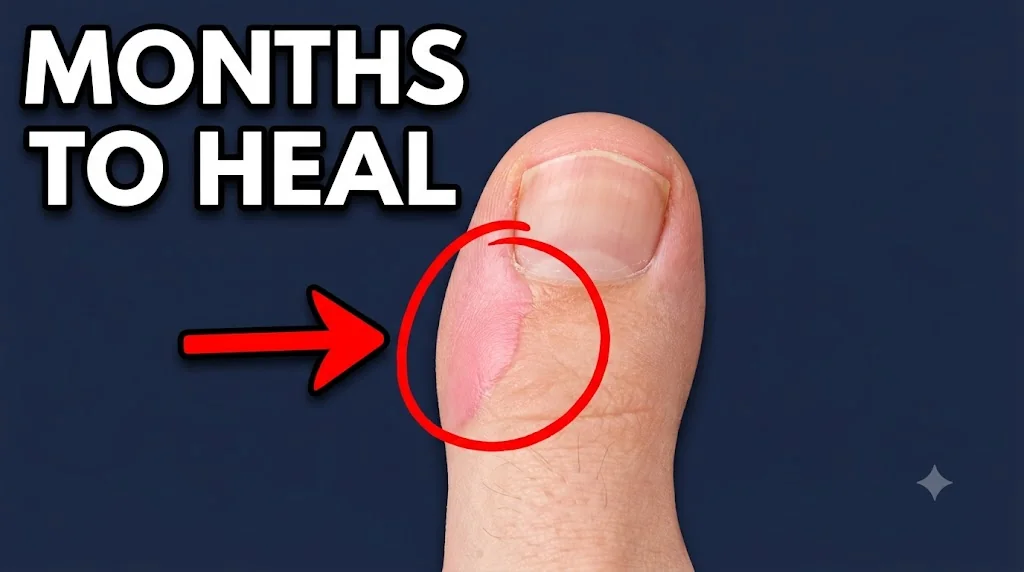
How long does nail fungus take to clear is one of those questions with a technically accurate answer that feels completely useless the first time you hear it: it depends. On the treatment you're using, on which nail is affected, on how long the infection has been there, and critically on what you mean by "clear." The fungus dying and the nail looking normal again are not the same event. They happen weeks or months apart, and nobody explains that gap clearly enough.
If you have nail fungus and are mid-treatment wondering whether it is working, this post gives timelines by treatment and the markers you can check yourself without a clinic appointment.
The Short Answer: Two Different Timelines You Need to Know
Treatment kills the fungus in weeks. Growing a clear nail takes months to over a year. Those are two entirely separate clocks, and almost every confusion about how long does nail fungus take to clear comes from blurring them together.
Here is the plain version: with oral antifungal medication, the fungus is typically eliminated what clinicians call a mycological cure within 6 to 12 weeks. But the nail plate that was infected while the fungus was active is already damaged. That nail does not repair itself. It grows out. Toenails grow at roughly 1mm per month, meaning a fully clear big toe nail can take 12 to 18 months to appear even when treatment has been entirely successful and no live fungus remains.
Dr. Cameron Rokhsar, a dermatologist and the founder of New York Cosmetic Skin & Laser Surgery Center, was asked whether toenail fungus can clear on its own and how long treatment takes before visible improvement:
"It's essentially a myth. The nail plate itself has no blood supply, so the immune system can't reach the fungus living in the keratin the way it can clear a skin infection, and once established it almost never resolves without treatment. What sometimes looks like spontaneous improvement is usually just the visible infected portion growing out toward the tip while fungus persists closer to the cuticle."
"Timelines run slower than people expect because toenails only grow about a millimeter a month. An oral terbinafine course is typically six to twelve weeks, but you won't see a fully clear nail until an entirely new, healthy nail has grown out from the base, which takes twelve to eighteen months for a big toe. Patients often quit early because nothing looks different after a few weeks, when in reality the new growth at the cuticle is the real marker of success, not the older nail further out."
Dr. Cameron Rokhsar, MD, FAAD, FAACS, Founder & Medical Director at New York Cosmetic Skin & Laser Surgery Center
Severity matters too. A mild early-stage infection with only a small portion of the nail affected will resolve faster than an advanced infection where the fungus has reached the nail matrix. If you caught it early, your timeline sits toward the shorter end of every range below. If you have had it for years, expect to be at the longer end.
How Long Oral Antifungal Medication Takes to Clear Nail Fungus
You have finally got a prescription. You want to know what the next several months will actually look like.
Before drilling into oral timelines specifically, it is worth understanding the full range of nail fungus treatment options oral, topical, and laser because the choice of treatment is the biggest single variable in how long clearance takes. For most cases beyond mild, oral antifungal medication is the first-line clinical recommendation, and the timelines are meaningfully better than topical options.
Terbinafine is the most commonly prescribed oral antifungal for nail fungus. The standard course is 250mg daily for 6 weeks for fingernail infections and 12 weeks for toenail infections, according to clinical dosing guidelines. Itraconazole is the common alternative, typically given as a pulsed dose one week on, three weeks off for two pulses for fingernails and three pulses for toenails. Both interrupt the fungus's ability to build its cell membrane, eventually killing it.
A mycological cure is the point at which lab testing confirms no living fungus remains distinct from the nail's cosmetic appearance returning to normal. Large clinical studies show terbinafine achieves mycological cure in approximately 76% of patients at 12 weeks. That is the fungus killed. The nail, however, is still growing out. According to the American Academy of Dermatology, full toenail regrowth after a fungal infection takes 12 to 18 months even after successful treatment, while fingernails take 4 to 6 months.
What you will notice during this period: the nail may look no better for the first 2 to 3 months, then a delineation line begins to appear at the base a line of healthy new nail growing in while the old infected nail remains visible above it. The nail does not suddenly become clear. It grows clear, slowly, from the bottom up.
One practical note on liver monitoring: terbinafine and itraconazole are processed by the liver, and your prescribing doctor may order baseline liver function tests before starting the course. This is standard protocol, not a sign of unusual risk. Most people complete oral antifungal courses without issue, but the monitoring exists for good reason.